The U.S. Air Force Test Pilot School has formally integrated three A-29C Super Tucano aircraft into its student flight curriculum, marking the first newly assigned aircraft for the school in nearly 30 years. The aircraft will begin training operations with class 25A as the first group of students to fly the platform.
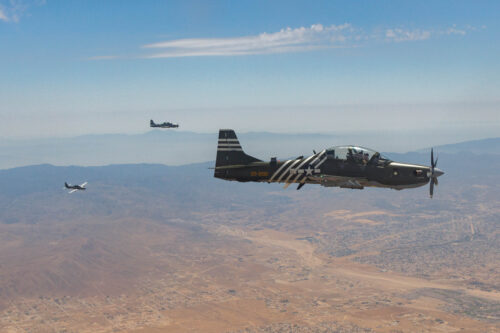
The integration represents a partnership between the Air Force Test Center and Sierra Nevada Corporation to repurpose a $63 million taxpayer investment. The three A-29C aircraft were originally acquired by Air Force Special Operations Command but were divested after mission requirements changed and subsequently stored at Davis-Monthan Air Force Base, Arizona.
The A-29C will serve as a multi-purpose training platform, with primary use for stall and spin training. The aircraft offers over one-and-a-half hours of endurance, allowing for multiple training repetitions that current platforms cannot provide. This capability will reduce operational strain on the F-16 fleet at Edwards Air Force Base while expanding training opportunities for all students.
The Super Tucano features modern avionics and mission systems including an MX-15 Sensor Ball, Link 16 communication, VORTEX link capability, and the ability to employ laser-guided bombs and rockets. With five weapon stations per aircraft, the platform will support future research and development efforts through the school’s Research Division. The A-29C enables training on multi-domain sensors and weapons while reducing reliance on T-38 and F-16 aircraft.
Following their arrival at Edwards, the aircraft underwent six months of extensive maintenance in collaboration with Sierra Nevada Corporation. During this period, instructors studied the aircraft systems and developed comprehensive training procedures. The school is currently adding special instrumentation for advanced data collection and exploring integration of the Agile Pod to enhance mission systems capabilities.
The A-29C represents a unique addition to the Air Force inventory, as it lacks formal training courses and is not used operationally by U.S. forces. This contrasts with the broader A-29 fleet, which is widely employed by allied nations for counter-insurgency and reconnaissance operations. The lightweight, multirole design makes it suitable for the school’s diverse training requirements.
Major Mateusz Borek, flight sciences assistant department chair and A-29 chief pilot for the test pilot school, was among three instructors who ferried the aircraft to Edwards without formal flight training on the type. They prepared by studying flight manuals, consulting with maintenance personnel, and completing qualification flights in similar aircraft including the T-6 Texan and PC-21. Borek noted that his test pilot school education provided the critical thinking and evaluation skills necessary for such scenarios.
The A-29C’s design features a backseat controller station that could accommodate combat systems officers and remotely piloted aircraft students as manned-to-unmanned teaming concepts develop. The aircraft will initially support stall and spin training before expanding to mission systems instruction, including Sensors Demo, Weapons Demo, and Mission Systems Practical Exam events.
“The decision to transfer A-29 aircraft to Edwards is a result of thoughtful analysis by the Test Pilot School and an excellent example of command agility and collaboration to take advantage of a unique, fleeting opportunity,” said Michael Banzet, director of Air Force Test Center plans and programs. Operations will continue to increase throughout the summer as the school integrates the aircraft into its curriculum.
For more information, hit the Source below