The U.S. Air Force announced it will not proceed with the planned beddown of 12 Republic of Singapore Air Force F-15 aircraft at Andersen Air Force Base, Guam, despite completing a comprehensive environmental review and beginning major infrastructure construction at the Pacific installation.
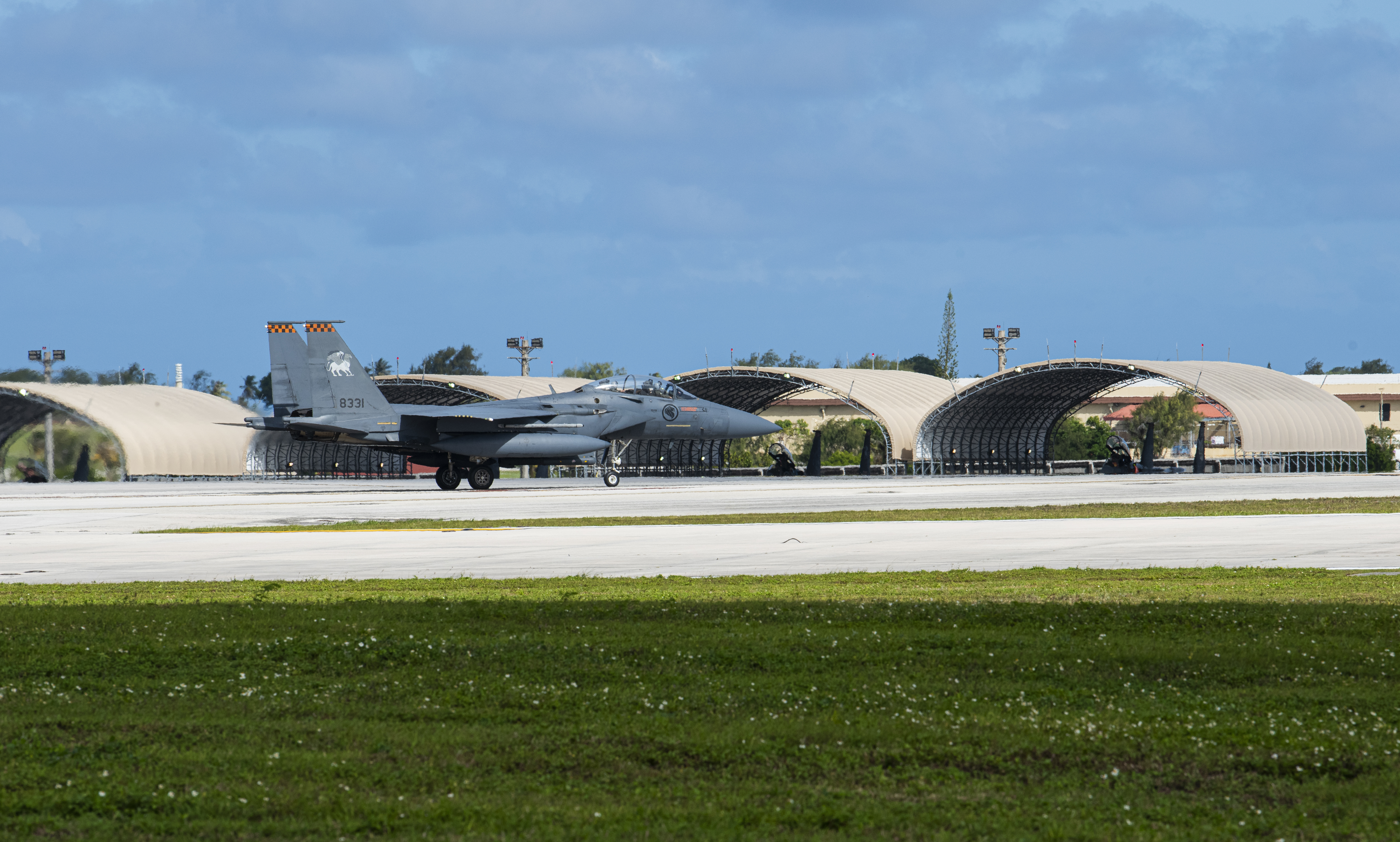
Acting Assistant Secretary of the Air Force Michael E. Saunders signed the Record of Decision on Jul. 16, 2025, confirming that while infrastructure upgrades will continue as planned, “the DAF will not implement or carry forward the beddown of up to 12 Republic of Singapore Air Force F-15 aircraft nor associated aircraft airfield operations.”
The decision marks the end of a defense partnership initiative that began with significant fanfare in December 2019, when Singapore Defense Minister Dr. Ng Eng Hen and then-US Defense Secretary Mark Esper signed a memorandum of understanding establishing the framework for an RSAF Fighter Training Detachment at Andersen AFB.
The original agreement would have created Singapore’s fourth military detachment on U.S. territory, joining existing F-16 and F-15SG operations in Arizona and Idaho, and AH-64 Apache helicopter training in Arizona. However, Singapore’s F-16 operations at Luke Air Force Base in Arizona are scheduled to relocate to Ebbing Air National Guard Base in Arkansas in 2027, where they will join a newly established F-35 detachment.
Planning for the deployment began in earnest in 2021 when the Air Force issued its initial Notice of Intent for an Environmental Impact Statement covering infrastructure upgrades at Andersen AFB. After a strategic pause to align the project with evolving Indo-Pacific initiatives, the service expanded the proposal in December 2023 to include the Singapore aircraft beddown alongside infrastructure construction.
The comprehensive environmental review, completed in April 2025, analyzed the impact of what would have been a substantial military expansion. The plan called for deploying 205 Singapore personnel and 35 family members to Guam beginning in 2029, with periodic training events bringing an additional 200 personnel twice yearly for four-week periods.
Despite canceling the aircraft deployment, the Air Force will proceed with extensive infrastructure construction at Andersen AFB. The North Ramp project encompasses 192 acres and includes 96 acres of new facilities, representing one of the largest military construction projects in the Pacific theater in recent years.
The infrastructure program includes approximately 20 acres of new airfield pavements, an aircraft hangar and maintenance facility, fuel receipt and distribution systems connecting to existing base infrastructure, and supporting utilities. Construction began in 2025 and is expected to continue for three to seven years.
The project’s scale suggests significant financial investment, with the concrete and steel requirements alone indicating costs exceeding $1 billion. The environmental impact statement noted that site preparation could require more than one million cubic meters of fill material, with some areas requiring up to 35 feet of additional elevation.
Saunders stated in the Record of Decision that the infrastructure “would provide options for parking, storing, maintaining, refueling, loading, and unloading aircraft on the installation, which would improve upon current strategic capabilities and posture with regard to ground maneuverability.”
The cancellation eliminates planned construction of three earth-covered magazines in Munitions Storage Area-1, which would have supported Singapore aircraft operations. However, the primary North Ramp infrastructure will accommodate “other DAF, service component, and partner nation aircraft or missions operating from Andersen AFB now or in the future.”
The decision reflects the complex intersection of military planning, environmental compliance, and shifting strategic priorities in the Indo-Pacific region. The environmental review identified “long-term, significant, adverse impacts on special status species” from construction activities, requiring a 151-acre forest enhancement area and extensive conservation measures coordinated with the US Fish and Wildlife Service.
Local economic impacts will be reduced from original projections. The Singapore deployment would have brought approximately 240 additional residents to Guam, generating demand for housing, services, and local spending. Construction activities will still provide economic benefits through an estimated 500 construction workers and local procurement, including fill material from Guam suppliers.
The Air Force has not disclosed specific reasons for canceling the Singapore component while proceeding with infrastructure construction. The decision comes amid broader strategic realignments in the Indo-Pacific, where the US military is adapting basing and partnership arrangements to address evolving regional challenges.
For Singapore, the cancellation requires alternative arrangements for F-15 training operations that were expected to begin in 2029. The island nation’s existing US-based detachments continue operations, and Singapore has developed training partnerships with Australia, India, and Thailand as alternatives to exclusive US-based programs.
The Andersen AFB infrastructure will enhance the installation’s capacity to support rotational deployments and exercises involving US and allied aircraft. Located on the westernmost US territory in the Pacific, Andersen AFB serves as a critical staging point for operations across the Indo-Pacific region.
Construction activities will continue under existing environmental mitigation requirements, including archaeological monitoring, species conservation measures, and stormwater management protocols. The Pacific Air Forces will develop a comprehensive Mitigation Plan within 90 days of the Record of Decision to ensure environmental compliance throughout the construction period.
For more information, hit the Source below