Competitors vying to replace the U.S. Navy’s T-45 Goshawk are expressing confidence as Boeing struggles with delays and production issues plaguing its T-7 trainer program.
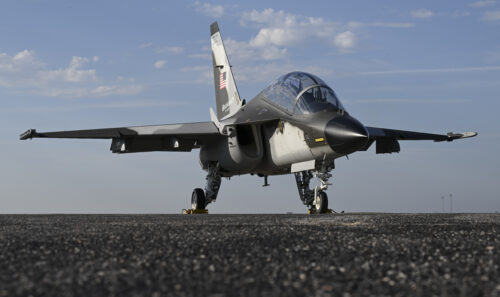
The M-346N is the proposed replacement for the T-45 Goshawk jet trainer for the U.S. Navy’s Undergraduate Jet Training System program and a product prepared for competition by Beechcraft in colloboration with Leonardo of Italy. (Textron Aviation photos by Greg L. Davis)
A consortium between Korea Aerospace Industries and Lockheed Martin has a strong chance of winning the Navy’s $7.2 billion advanced jet trainer contract, according to South Korean defense industry sources cited in a report by The Korea Economic Daily written by Sang-Hoon Sung.
Meanwhile, Textron Aviation Defense launched a nationwide tour this week to showcase its Beechcraft M-346N as a “ready-now” solution for the Navy’s Undergraduate Jet Training System program, with the aircraft departing from the company’s Wichita, Kansas facility.
The U.S. Navy competition to replace its aging T-45 Goshawk training aircraft has drawn three major defense consortiums vying for a contract to supply between 145 and 220 advanced jet trainers. Proposals are due in December, with the service expected to select a preferred supplier in 2026 and finalize the contract award in January 2027.
Boeing faces mounting challenges in the competition despite previously winning a $12 billion contract in 2018 to supply its T-7A Red Hawk to the US Air Force. The company’s T-7B proposal for the Navy is based on the same platform, but delivery of the Air Force variant has been delayed from 2023 to 2026 due to testing and production issues. A month-long engineers’ strike at Boeing has further raised concerns about the company’s manufacturing reliability.
Textron Aviation Defense, partnering with Italian aerospace firm Leonardo, is promoting the Beechcraft M-346N as a “ready-now” solution. The aircraft is based on Leonardo’s proven M-346 platform, which has accumulated more than 150,000 flight hours across 100 aircraft in service with 20 international operators.
The competition comes as the Navy seeks to modernize its pilot training pipeline for fourth and fifth-generation fighter aircraft. The current T-45 Goshawk fleet, also manufactured by Boeing, requires replacement due to age and evolving training requirements for carrier-based operations.
The KAI-Lockheed Martin consortium is pitching their TF-50N as a battle-tested platform already in service with air forces in South Korea, Indonesia, Iraq, and the Philippines. “KAI has a very high chance of winning the bid,” a South Korean defense industry official told The Korea Economic Daily. “A first-of-its-kind development may be on the horizon.” Under their partnership structure, KAI would handle airframe manufacturing while Lockheed Martin manages software integration and systems customization for U.S. Navy requirements.
Defense industry sources indicate the Korean consortium has modified cockpit seating and interior space specifically to accommodate American pilots, demonstrating their commitment to meeting Navy specifications. The partnership leverages KAI’s manufacturing expertise with Lockheed Martin’s extensive experience in U.S. defense contracts.
Boeing’s T-7B offering builds on the company’s long history of supplying training aircraft to American forces. However, the ongoing delays with the Air Force T-7A program have created uncertainty about Boeing’s ability to deliver on schedule. The T-7B represents a derivative of the Red Hawk design, adapted for naval aviation training requirements.
The Textron-Leonardo alliance emphasizes operational readiness and proven performance. Their M-346N would be assembled at Textron’s facility in Wichita, Kansas, building on Beechcraft’s 85-year history of training US military pilots. The platform offers integrated training systems including high-fidelity simulators, artificial intelligence-powered instruction, and Live-Virtual-Constructive architecture that links aircraft with ground-based training devices.
All three aircraft feature advanced safety systems and fly-by-wire controls designed for modern pilot training. The Navy’s requirements emphasize capabilities specific to carrier operations, including precision landing systems and the ability to simulate the demanding flight characteristics of carrier-based fighters.
With proposals due within months, each consortium is working to demonstrate their platform’s readiness and capability to meet the Navy’s demanding requirements. The final selection will shape U.S. naval aviation training for decades to come while potentially reshaping the global market for advanced jet trainers.
For more information, hit the Source below