Royal Canadian Air Force (RCAF) CF-188 Hornet fighters successfully completed touch-and-go landings on a section of Estonian highway on Oct. 13, marking the first time Canada’s fighter force has conducted such operations. The maneuvers, performed on the Jägala-Käravete section of Piibe Highway, demonstrate the RCAF’s operational progress in adopting dispersed operations concepts under NATO’s collective defense framework.
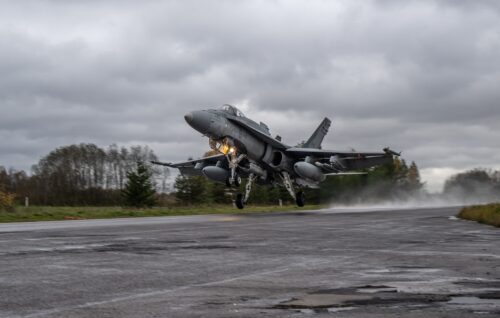
Photo: Master Corporal Bélynda Casse, Imaging Servic
Photo: Master-Corporal Bélynda Casse, Imaging Services, 3 Wing Bagotville
The highway landing operations took place during Exercise TARASSIS 25 as part of Operation REASSURANCE, Canada’s largest international military commitment. Lieutenant Colonel Maxime Renaud, Commander of the Air Task Force for Operation REASSURANCE, emphasized the operational significance of the training evolution.
“Conducting these types of operations in Estonia allows our teams to practice with minimal capabilities, including landing on highways,” Renaud said. “This demonstrates our ability to rapidly respond, support, and deploy air power in unpredictable environments, whether supporting NATO allies abroad or fulfilling our NORAD mandate at home.”
The exercise involved CF-188 Hornets from 3 Wing Canadian Forces Base Bagotville performing repeated touch-and-go landings on the temporarily configured tactical landing zone. An Estonian Air Force M28 Skytruck transport aircraft also conducted low-altitude passes over the highway airfield during the cooperative training event.
The deployment to Estonia represents the second phase of a six-week air task force mission that began with the departure of approximately 160 RCAF personnel from CFB Bagotville on Sept. 4. The initial phase saw the full contingent participate in Exercise COBRA WARRIOR 25-2 at Royal Air Force Waddington in the United Kingdom, the largest air exercise hosted by Britain. Following COBRA WARRIOR, 80 RCAF members continued to Estonia for TARASSIS 25, operating from Ämari Air Base.
The air task force package includes eight CF-188 Hornets, one CC-130H Hercules from 435 Transport and Rescue Squadron operating out of 17 Wing Winnipeg, and support aircraft from 8 Wing CFB Trenton that provided transatlantic escort and refueling capabilities. During TARASSIS 25, the Hornets have been conducting air defense, ground attack, and support missions.
Major General Chris McKenna, Commander of 1 Canadian Air Division, described the strategic value of the exercises in developing future capabilities. “The strategic partnerships developed during Exercises COBRA WARRIOR and TARASSIS will enable the development of the RCAF’s future capabilities and operational agility,” McKenna said. “In strengthening ties with our NATO allies, set to the backdrop of an intense and demanding training environment, the RCAF stands to gain a great deal in terms of our ability to be prepared for, and help solve, the challenges facing the Canadian Armed Forces into the coming decade.”
The highway landing operations directly support the RCAF’s implementation of Agile Combat Employment and Agile Operations Employment concepts, doctrinal frameworks that emphasize flexibility and survivability through dispersed operations. These principles enable air forces to operate from locations away from established air bases, complicating adversary targeting and enhancing force survivability in contested environments.
The use of highways as tactical landing zones has become an increasingly important element of NATO air operations planning in Eastern Europe. The concept allows fighter aircraft to operate from dispersed locations with minimal infrastructure, reducing dependence on large air bases that could be vulnerable to attack. The Piibe Highway section used during the exercise was temporarily reconfigured to accommodate aircraft landing operations.
Exercise TARASSIS 25 is a Joint Expeditionary Force-led multinational training event running from Sept. 2 to Oct. 17. The JEF is a coalition of northern European nations focused on rapid response capabilities and regional security. The exercise emphasizes allied interoperability and operational readiness in a European context, with participating forces training in contested, degraded, and operationally limited environments.
This marks the third consecutive year the RCAF has participated in Exercise COBRA WARRIOR, with the service’s inaugural involvement occurring in 2023. The continued participation reflects Canada’s sustained commitment to NATO’s enhanced forward presence in Central and Eastern Europe, a posture strengthened following Russia’s invasion of Ukraine.
Operation REASSURANCE, which began in 2014, encompasses land, maritime, air, space, and cyber elements deployed to strengthen NATO’s collective defense posture. The operation represents Canada’s commitment to the security and stability of the Euro-Atlantic region and demonstrates the interoperability of Canadian forces with NATO allies.
The successful highway landing operations also carry implications for RCAF operations in other theaters. The ability to operate from austere locations with minimal infrastructure could prove valuable in Arctic operations, where vast distances and limited facilities present similar operational challenges to those addressed by Agile Combat Employment concepts.
The RCAF has been conducting composite air operations designed to train participants in high-intensity, large-scale tactical air warfare operations. Both COBRA WARRIOR and TARASSIS provide realistic training environments that test the ability of air forces to maintain operations under challenging conditions while working closely with multinational partners.
The CF-188 Hornet, which has served as Canada’s primary fighter aircraft since 1982, is scheduled to be replaced by the F-35A Lightning II in the coming years. The operational experience gained through exercises like TARASSIS 25 will inform training and doctrine development for the future fighter fleet, ensuring continuity of capabilities as the RCAF transitions to its next-generation platform.
The deployment will conclude in mid-October, with participating aircraft and personnel returning to their home bases in Canada. The lessons learned from both the COBRA WARRIOR and TARASSIS exercises will be integrated into RCAF training programs and operational planning as the service continues to develop its expeditionary capabilities and strengthen partnerships with NATO allies.
For more information, hit the Source below