Twenty-four British and French helicopters executed an “elephant walk” formation at Wattisham Flying Station in Suffolk this week, marking the launch of Exercise Pinion Titan, one of NATO’s largest aviation training operations this year.
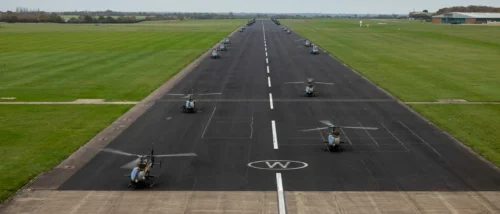
Photo: British Army
The dramatic runway display, which saw eight Apache attack helicopters, ten Wildcat reconnaissance aircraft, two Chinook transport helicopters, and four French Gazelle helicopters taxi in formation before lifting off together, signals the operational readiness of up to 50 helicopters and 2,000 troops who will train across the United Kingdom through the end of November.
“An elephant walk is a striking demonstration of strength and readiness,” said Brigadier Nick English, Commander of 1st Aviation Brigade, which is leading the exercise. “Preparing four different types of aircraft to fly together is a significant engineering and logistical achievement. It proves to us and to potential adversaries that we have the teamwork and coordination needed for real-world combat operations.”
The exercise brings together forces from the British Army, Royal Air Force, France’s Armée de Terre, and the U.S. Army, deploying approximately 1,000 vehicles alongside the helicopter fleet. The scale and complexity of the operation demonstrates the heightened readiness posture of NATO forces amid evolving security challenges in Europe.
Exercise Pinion Titan represents a significant milestone for the 1st Aviation Brigade, marking the completion of a modernization program that began when the brigade was formed in 2020. According to Brigadier English, every soldier, vehicle, and helicopter in the brigade’s inventory will participate in field operations designed to test their integrated capabilities.
“This exercise demonstrates that 1st Aviation Brigade is one of NATO’s most capable and ready formations, prepared to defend the UK and our allies,” English said.
The training operation is structured around two battlegroups led by 3 Regiment and 4 Regiment Army Air Corps. Planning officers from the U.S. Army’s 12th Combat Aviation Brigade are embedded with 4 Regiment, adding an additional layer of allied integration to the exercise. Following initial training at Wattisham, forces will disperse to establish operating bases across northern England, conducting missions that will span from the Scottish Highlands to Salisbury Plain.
The exercise will rehearse the full spectrum of combat aviation operations. Deep strike missions will see Apache and Gazelle attack helicopters penetrating far behind simulated enemy lines to engage targets such as artillery positions and supply depots, operations designed to degrade enemy capabilities before they can affect friendly forces at the front. Air assault operations will test the RAF’s 18 Squadron Chinook helicopters in their primary mission of rapidly deploying paratroopers and equipment into combat zones, with Apache and Gazelle helicopters providing armed escort and fire support.
Wildcat helicopters from 1 Regiment Army Air Corps will conduct reconnaissance operations, using their advanced sensors and targeting systems to gather intelligence that will inform mission planning for the battlegroups. Supporting the entire operation, the Brigade Support Force will provide the critical logistics backbone, delivering everything from ammunition to meals while maintaining the complex fleet of aircraft in field conditions.
The participation of French forces from the 3e Régiment d’Hélicoptères de Combat underscores the deepening military cooperation between Britain and France that began with the 2010 Lancaster House Treaties. The bilateral defense agreements committed both nations to closer integration of their armed forces and joint development of military capabilities.
Capitaine Damien, commander of the French contingent, expressed enthusiasm for the partnership. “We are very proud to participate in this major exercise, which is a great opportunity to enhance our operational readiness,” he said. “For most of the soldiers, it is their first time working with allied forces, but we can see that France and Britain share a common military culture. This will lead to smooth integration and the development of a joint force with solid tactical capabilities.”
The exercise also incorporates cutting-edge military technology, including unmanned aerial systems and advanced communications networks, testing the brigade’s ability to integrate emerging capabilities with traditional combat aviation assets.
The timing and scale of Exercise Pinion Titan sends a clear message about NATO’s readiness and the alliance’s ability to rapidly concentrate capable forces. The exercise demonstrates not only the technical proficiency of participating units but also the political will of allies to maintain interoperable forces capable of conducting complex combined operations.
For more information, hit the Source below