Japan’s Acquisition, Technology & Logistics Agency (ATLA) began distributing technical materials on Jan. 16 from its 2025 symposium, revealing significant progress on a missile development program that fundamentally changes how stand-off weapons operate. The Island Defense New Anti-Ship Guided Missile program will conduct a major flight test in fiscal year 2027 that demonstrates something unusual in missile warfare: two missiles working together, with one finding targets and the other destroying them.

Source: ALTA
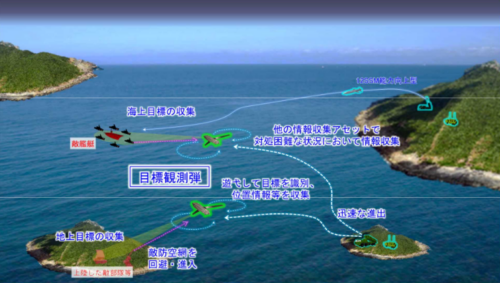
The test, designated Launch Test #2, will fly two variants of the same basic airframe. One variant carries an infrared seeker for terminal attack. The other carries electro-optical and infrared sensors on the nose, designed purely to gather intelligence on enemy ships and ground targets. The intelligence-gathering missile will identify targets and can transmit that data to strike missiles, creating what amounts to an autonomous kill chain that operates independently of vulnerable reconnaissance platforms like large drones or manned aircraft.
The concept addresses a persistent problem in modern warfare. Stand-off fires require precise targeting data, but the reconnaissance assets that normally provide that data—satellites, large UAVs, manned aircraft cannot survive in contested airspace against sophisticated air defense systems. Japan’s solution separates the reconnaissance and strike functions into different missiles that share the same speed, maneuverability, and stealth characteristics, then networks them together.
Two Missiles, One System
Launch Test #2 represents a major expansion in scope and complexity from the program’s first launch test, conducted in fiscal year 2025. That earlier test focused on basic integration of the turbofan engine and airframe. An ejection test in 2024 verified the missile could safely separate from its booster and start its engine. The upcoming test evaluates whether the multi-role concept actually works in practice.
The test will use two differently configured missiles, both significantly larger than the airframe tested in 2025. One specimen measures approximately 1.3 times the length of the first test article, while the other is roughly 1.6 times longer. Both specimens demonstrate the platform’s open architecture design, where a common airframe accepts different mission modules.
Specimen A, designated the guided missile type, carries an infrared seeker and represents a conventional strike weapon configuration. It proves the platform works as an anti-ship or land-attack missile. Specimen B, the target information collection type, takes a different approach. Instead of a warhead, it carries an EO/IIR sensor module and serves as what Japanese defense planners call a Target Observation Projectile.
The Intelligence-Gathering Missile
The Target Observation Projectile addresses what Japan’s Ministry of Defense identified as a critical capability gap. The system emerged from a separate but related development program that began in fiscal year 2023 with a budget of ¥22.2 billion over four years.
The requirement is straightforward. When large UAVs and other conventional reconnaissance platforms cannot penetrate enemy air defenses, and when stand-off missiles need targeting data to engage ships or ground targets at maximum range, something has to get close enough to positively identify targets and determine their precise locations. That something needs to survive in an environment that would destroy a Reaper-class drone or force a manned aircraft to turn away.
Japan’s answer is a missile that looks and flies like a strike weapon but carries sensors instead of explosives. The Target Observation Projectile uses the same basic airframe from the Island Defense New Anti-Ship Guided Missile, giving it comparable speed, maneuverability, and low observability. It can penetrate air defense networks by presenting the same small radar cross-section and evasive flight profile as an attacking missile.
Once near the target area, the missile transitions to a loiter mode. This requires what ATLA calls “high-speed transit and extended loiter technology” the ability to sprint to distant target areas at missile speeds, then slow down and remain airborne long enough to conduct a thorough search. The EO/IIR sensors scan for ships and ground targets, identify specific vessel types or installations, and in some cases determine vulnerable points on the target.
The missile processes this information in flight using what the technical documents describe as “target location processing and data transmission technology.” This involves calculating precise target coordinates from the search area and formatting that data for transmission to ground control stations. The ground stations can then use that information to support firing decisions and create targeting solutions for stand-off anti-ship missiles. The system implements what Japanese planners call Up-To-Date Command (UTDC) providing current rather than stale intelligence for time-sensitive targeting.
Seven Core Technologies
The materials released on Jan. 16 detail seven key technology areas under development for the Island Defense New Anti-Ship Guided Missile, each addressing specific operational requirements for missions in contested environments.
The open architecture and modularization approach applies modular design principles to create what ATLA calls a “multi-purpose airframe.” The common sections of the missile can accept different mission modules, allowing the same basic platform to serve as a strike weapon, reconnaissance asset, or potentially other roles. This design philosophy enables third-party development and modification of modules without redesigning the entire missile. The approach reduces development costs for derivative variants and allows the system to adapt to evolving mission requirements.
Stealth technology focuses on minimizing radar cross-section through several design features. The airframe uses edge management techniques and curved intake duct to control radar reflections. The design eliminates seams and protruding components where possible, creating smooth external surfaces. These features combine to give the missile what ATLA describes as extremely high stealth characteristics, allowing it to approach defended targets with reduced probability of detection.
High-maneuverability technology incorporates large wing surfaces that reduce wing loading, giving the missile the agility to evade close-in weapon systems and surface-to-air missiles during terminal approach. The symposium materials indicate this capability is essential for survivability against layered air defenses, where even low-observable missiles may be detected at short range and engaged by rapid-fire gun systems or infrared-guided missiles. The missile can be seen executing a series of barrel rolls in an official video clip that was released to the public.
The long-range capability depends on a compact, high-performance turbofan engine designated XKJ301-1. The engine uses a two-spool design that improves fuel efficiency compared to single-spool configurations. Electrically driven accessories reduce the engine’s external diameter, allowing it to fit within the slender airframe while still providing the thrust needed for sustained flight at operationally relevant ranges. The engine underwent extensive component testing, including separate trials of the fan, compressor, combustor, and turbine sections, before full integration.
Seeker and AI technology represents one of the more sophisticated aspects of the program. The system employs dual-mode seekers and infrared imaging capabilities to identify targets in complex backgrounds. AI algorithms assist in distinguishing specific ship classes or ground installations and can identify vulnerable points on targets for precision engagement. This capability proves particularly valuable for the target information collection variant, where accurate classification of targets determines whether strike missiles engage or search for higher-priority threats.
Warhead technology ensures effectiveness against both naval vessels and hardened ground targets. The warhead design provides performance equal to or better than existing anti-ship missiles while adding multi-role capability. Fragmentation testing at the MBDA subsidiary TDW Gmb test facility in Germany validated the warhead’s effectiveness, measuring fragment dispersion patterns to confirm adequate coverage against ship superstructures and ground installations.
Data link technologies enable the networked operations that distinguish this system from conventional missiles. The program is developing bidirectional satellite data link equipment that maintains connectivity with ground stations throughout flight. Inter-missile communication equipment allows direct exchanges between missiles in the same strike package, supporting cooperative engagement and formation flight. These data link systems underwent testing separately from the complete missile, validating performance before integration into flight test articles.
Networked Operations
The fiscal year 2027 test goes beyond demonstrating that each variant works independently. The primary objective is verifying that multiple missiles can cooperate in flight, sharing data and coordinating their actions without continuous ground control. Both test specimens will carry inter-missile communication equipment and satellite data links.
The inter-missile communication allows direct exchanges between missiles in the same strike package. If the intelligence-gathering missile identifies multiple targets, it can in theory distribute that information to several strike missiles, each programmed to attack a different ship or installation.
This operational concept represents a departure from traditional sensor-to-shooter architectures. Conventional targeting cycles involve a reconnaissance platform detecting targets, transmitting that data to a command post, having human operators or automated systems process the information and assign weapons, then sending fire control data to launchers. That cycle takes time and depends on communication links that adversaries actively try to disrupt.
The networked missile approach compresses the timeline by putting sensors and shooters in the same battlespace simultaneously. The intelligence-gathering missile identifies targets while strike missiles are already in flight, potentially already approaching the target area. Target data goes directly from one missile to another. The fire control solution updates in real time as the intelligence-gathering missile refines target locations or identifies higher-priority threats.
Source: ALTA
An Expendable ISR Asset
The concept accepts something that would be unthinkable with conventional reconnaissance platforms: attrition. A Target Observation Projectile costs a fraction of what a large UAV costs and carries no aircrew. If enemy air defenses shoot it down after it transmits targeting data, the mission still succeeds. This calculus allows the system to take risks that manned aircraft cannot and to operate in threat environments where even unmanned platforms are too valuable to risk.
The approach also provides redundancy. A strike package might include multiple intelligence-gathering missiles, ensuring that if one is destroyed before completing its reconnaissance, others can take over. The missiles share information through their data links, building a composite picture of the target area that persists even if individual sensors are lost.
Integration with Japan’s stand-off strike systems provides the broader context. The Type 12 Surface-to-Ship Missile Capability Improvement Type extends engagement ranges to the point where targeting becomes genuinely difficult. A ship or ground launcher firing from maximum range needs to know not just that an enemy ship is somewhere in a general area, but its precise location, heading, and speed. Conventional intelligence sources may provide that information, but they may not be useful if the enemy has established effective air defenses or is jamming reconnaissance satellites.
The Target Observation Projectile ensures the targeting data exists when needed. It travels ahead of the strike missiles, penetrates the same defenses, and operates in the same denied environment. If it survives long enough to identify and locate target then strike missiles will have current, precise targeting data regardless of whether any other intelligence source is available.
Development Progress
The program builds on extensive ground testing and component validation conducted over the past several years. The released materials document trials ranging from basic component characterization to full-scale systems integration.
Engine development followed a systematic approach, with separate testing of each major section. Fan trials at Kawasaki Heavy Industries’ Akashi facility validated aerodynamic performance and efficiency. Compressor testing confirmed pressure ratios and surge margins. Combustor trials verified ignition reliability and emissions characteristics across the operating envelope. Turbine testing validated blade cooling and efficiency under high-temperature conditions. A high-altitude performance test at ATLA’s Chitose facility confirmed the engine operates properly in conditions simulating flight at operational altitudes.
Aerodynamic validation combined wind tunnel testing with computational analysis. Low-speed wind tunnel trials at KHI’s Gifu facility evaluated launch dynamics and control surface effectiveness during the critical transition from booster-assisted flight to sustained cruise. Transonic wind tunnel testing characterized airframe behavior across the speed range, including intake performance and control authority. Full-airframe radar cross-section measurements at the New Generation Equipment Technology Research Institute’s Iioka facility confirmed stealth characteristics matched predictions.
The warhead underwent static detonation testing to validate fragmentation patterns and blast effects. Shock testing at IMV’s Osaka facility subjected engine assemblies to vibration and impact loads simulating launch acceleration and flight dynamics, confirming structural integrity and continued operation under operational stress.
System-level integration testing brought the components together. Full-airframe operational trials at KHI’s Akashi plant verified that control systems, navigation equipment, and propulsion integrated properly. The 2024 ejection test at the Ground Self-Defense Force’s Yausubetsu training area demonstrated booster separation, engine ignition, and wing deployment in an operational launch scenario. Launch Test #1 in 2025 at the Air Equipment Research Institute’s Niijima facility confirmed the complete system functioned as designed under flight conditions.
Strategic Context
Japan’s emphasis on stand-off capabilities reflects its strategic geography and the regional threat environment. Island defense requires the ability to engage enemy forces and their supporting ships at long range, ideally before they close within range of Japan’s home islands. Relying on air superiority for targeting is risky when potential adversaries field large numbers of modern fighters and extensive surface-to-air missile systems.
The modular missile approach also has industrial implications. A common airframe that accepts different mission modules reduces development costs for future variants. The technical documents reference the potential for family-wide commonality, where electronic warfare versions, decoy variants, or other specialized configurations share most components with the baseline design. This approach reduces the per-unit cost of any individual variant and simplifies logistics.
The symposium materials released in January provide unusual transparency into a program that could influence missile design beyond Japan. Other nations face similar challenges with targeting in contested environments. If Japan demonstrates that missiles can reliably perform reconnaissance while networked with strike weapons, the concept may inform future development programs in allied nations or prompt development of countermeasures by potential adversaries.
For more information, hit the Source below
P-31