American military leaders faced intense scrutiny from lawmakers on Feb. 9 over the V-22 Osprey’s troubled safety record, with accident rates spiking nearly 90 percent above historical averages and 20 service members killed between fiscal years 2022 and 2024.
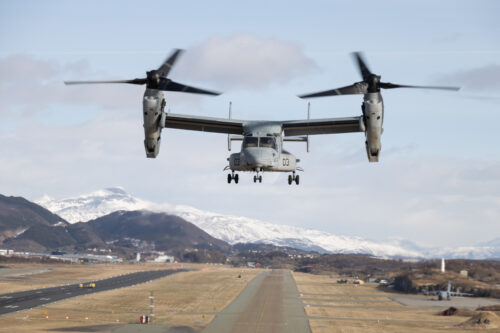
The joint hearing by House Armed Services subcommittees examined findings from two major reviews released in December that painted a sobering picture: 28 serious safety risks left unresolved for a median of nine years, fragmented communication between services, and mission-capable rates languishing around 40 to 50 percent across the fleet.
“The problem is not identifying risks,” Diana Moldafsky, director of Defense Capabilities and Management at the Government Accountability Office, told lawmakers. “The problem is closing them.”
Vice Admiral John Dougherty, commander of Naval Air Systems Command, and Brigadier General David Walsh, the V-22 program executive officer, acknowledged the challenges while defending the aircraft’s unique capabilities and outlining corrective measures already underway.
Sharp Rise in Fatal Accidents
The GAO report revealed that Marine Corps and Air Force Osprey accident rates for the most serious mishaps—those classified as Class A and Class B—rose sharply in fiscal years 2023 and 2024. The Marine Corps rate jumped 36 percent above its eight-year average, while the Air Force rate soared 88 percent above its historical baseline.
Class A and B accidents involve death, permanent disability, extensive hospitalization, property damage of $600,000 or more, or a destroyed aircraft. The Osprey consistently exceeded serious accident rates for most other Navy and Air Force aircraft types during the 10-year period the GAO examined.
Most accidents stemmed from multiple causes, Moldafsky said, with 57 percent involving material failures combined with human error tied to supervision, training and risk management. The fatal November 2023 crash off Japan that killed eight Air Force special operations personnel led to a fleet-wide grounding lasting more than three months and prompted both the NAVAIR comprehensive review and the GAO investigation.
The Navy variant, which began operational use in fiscal year 2021, had not experienced a Class A or Class B accident through fiscal year 2024, though its fleet size of 41 aircraft is significantly smaller than the Marine Corps’ 348 or the Air Force’s 52.
Unresolved Risks Languish for Years
Admiral Dougherty told the committee that of 79 system safety risk assessments identified since 2010, 34 remained either open or in monitor status as of June 2025. Nineteen assessments remained completely open, meaning the risk was identified but not yet analyzed or addressed with procedural or material solutions.
The median age for the 28 unresolved risk assessments—excluding six general military aviation risks accepted for the life of the program—stood at about nine years. Over half had been unresolved for between six and 14 years.
More troubling, the Osprey had more unresolved “catastrophic” risks—those involving death, permanent total disability, or aircraft loss—than all but one other Department of the Navy aircraft. These risks have been unresolved on average for longer than any other aircraft in the Navy’s inventory, according to GAO’s analysis of NAVAIR data.
Dougherty pledged that safety remains “our top priority” and said the Navy and Marine Corps are implementing all 32 recommendations from the comprehensive review, with 24 already closed.
Communication Gaps and Stovepiped Information
A recurring theme in both reports was the failure to share critical safety information across the three services operating the Osprey. Pilots and maintenance crews told investigators that hazard and accident data remained “stovepiped,” with no regular forum for sharing emergency procedures.
The GAO found that the program office had not proactively shared information from hazard and accident reporting with Osprey units and safety personnel in other services. The investigation into the fatal November 2023 crash revealed that the program office did not communicate findings from previous proprotor gearbox safety risk assessments, limiting opportunities for service-specific changes to guidance and training.
“What we consistently heard from the squadrons is that right now this is an informal process,” Moldafsky said. Service members talk to each other, she explained, but there’s nothing formalized to ensure lessons learned in one service reach the others before an accident occurs.
Representative Joe Courtney, ranking member of the Seapower and Projection Forces subcommittee, said interviews in the GAO report revealed pilots confident in the aircraft but worried about unknown risks. “We’re not worried about what we know, we’re worried about what we don’t know,” he quoted from the report.
The GAO also found that the military services had not convened a multi-service conference to share Osprey aircraft knowledge and emergency procedures for five years, from 2020 to 2025. While the services held a conference in May 2025, they had not formalized plans to continue doing so regularly.
In response, military leaders pointed to new oversight structures, including the Joint V-22 Leadership Forum established in January 2026. The forum brings together senior leaders from the Navy, Marine Corps and Air Force to review safety and readiness metrics, with annual reports to service vice chiefs.
General Walsh said the program office includes personnel from all three services working together daily, supplemented by monthly safety reviews, semi-annual program boards and regular working groups.
Mechanical Failures Drive Readiness Crisis
The Osprey’s complex tiltrotor design has created persistent mechanical challenges. The proprotor gearbox, which enables the aircraft’s unique ability to transition between helicopter and airplane modes, has experienced cracking due to microscopic impurities in the steel.
Admiral Dougherty reported that a gearbox crack was detected just last week, though the pilot landed safely following established procedures. The Navy has begun fielding improved gearboxes made with triple-melt X-53 steel at a rate of 12 per month. Officials said the new steel and manufacturing process represents cutting-edge technology for aircraft drive systems and should reduce microscopic material impurities by an order of magnitude, downgrading the risk from serious to medium.
At the current production rate, upgrades for Navy and Air Force aircraft should be complete between 2027 and 2029, though the Marine Corps fleet will take longer given its size.
Another critical issue involves hard clutch engagements in the input quill assembly, which previously caused dangerous in-flight incidents. General Walsh said the program has achieved zero hard clutch engagements since implementing flight hour limits in February 2023, accumulating over 127,000 flight hours without incident. A redesigned assembly currently in testing should be fielded by late 2027.
The mechanical problems have taken a toll on readiness. Marine Corps Ospreys are operating at roughly 50 percent mission-capable rates, while Navy aircraft hover around 40 percent. Operating costs per flight hour have jumped 30 percent over the past four years.
Representative Jack Bergman, chairman of the Readiness subcommittee and a former Marine Corps aviator, called the readiness trends “out of line with the balance of the naval aviation enterprise.” He noted that excessive numbers of aircraft are being cannibalized for parts to keep the rest of the fleet flying.
The GAO noted that maintenance and operational risks were considered outside the scope of safety working groups despite being major contributors to accident data. Units described heavy maintenance workloads that reduced aircraft availability and limited aircrew experience, but these risks are not consistently captured in risk mitigation plans.
Non-System Risks Fall Through the Cracks
The GAO identified a critical gap in how the Pentagon addresses safety risks. While the program office uses system safety risk assessments to track potential material failures of airframe and engine components, it does not systematically identify, analyze or respond to non-system risks associated with maintenance and operations.
Moldafsky explained that operating forces had raised maintenance and aircrew challenges as top safety issues, but the program office’s process deemed these concerns out of scope because they relate to the military services’ authorities to manage personnel and training. As a result, these non-system risks did not undergo formal risk analysis or generate action plans.
The GAO found mismatches in maintenance skill and proficiency levels presented safety risks for squadrons because maintenance personnel are stretched thin, limiting units’ ability to consistently provide ready aircraft for training. Similarly, aircrew experience levels have presented safety concerns because Osprey pilots were moving through initial training and qualification faster than in prior years, limiting training opportunities to build experience.
“Without refining the joint program’s process for identifying, analyzing and responding to all safety risks, including incorporating and prioritizing system and non-system safety risks, the Program Office and the military services cannot determine which risks must be eliminated or mitigated and which risks can be accepted,” Moldafsky said.
Mid-Life Upgrades and Future Fixes
The V-22 has operated for 20 years without a mid-life upgrade, something both reviews identified as a significant gap. NAVAIR and the program office are now developing modernization plans for the drive system, airframe and avionics that officials say will keep the aircraft flying through the 2050s.
One initiative already showing promise is the nacelle improvement program. The Air Force implemented the upgrades on its CV-22B variant and saw aircraft availability increase by more than 20 percent, mean flight hours between failures rise by over 1,500 hours, and mean maintenance hours per flight hour decrease by more than two hours. The Marine Corps and Navy are working to adopt similar improvements.
The program is also fielding the Osprey Drive System Safety and Health Information system, which provides maintainers and aircrews real-time data on gearbox vibrations to catch problems before they become critical.
General Walsh outlined additional upgrades including cockpit technology replacements to address obsolescence issues and a broader aircraft modernization plan. When asked about funding, he said the most urgent safety improvements are fully funded, though some longer-term initiatives are still being studied for future budgets.
Calls for Legislative Action
Several lawmakers drew parallels to the deadly 2017 collisions of the USS Fitzgerald and USS John S. McCain, which killed 17 sailors and prompted sweeping reforms to surface fleet training and operations. At the insistence of the late Senator John McCain, many of those recommendations were codified into law through the National Defense Authorization Act.
“I view these reviews in the same light,” Courtney said. He suggested Congress consider similar legislative action to ensure V-22 reforms are implemented and sustained, rather than allowed to fade.
Chairman Trent Kelly agreed, telling the witnesses that he and Courtney want to work with the military to “make legislation to codify some of the things we have coming forward, because we not only want to do it, we want to do it right.”
Ranking member John Garamendi asked the witnesses to provide specific recommendations for inclusion in this year’s defense authorization bill by the end of February. “Please get back to us with very specific suggestions about what you need,” he said, noting that waiting until 2033 or 2034 for full upgrades is “simply too far out and not acceptable.”
The request puts pressure on military leaders to identify whether they need additional funding, legal authorities or other congressional action to accelerate safety improvements.
Five Recommendations for Change
The GAO made five specific recommendations to the Department of Defense, all of which DOD agreed to implement:
First, refine the Osprey joint program’s process for identifying, analyzing and responding to all safety risks, including incorporating and prioritizing both system and non-system safety risks.
Second, establish an oversight structure with clearly defined roles and responsibilities to ensure the timely resolution of known Osprey safety risks.
Third, ensure a process exists to proactively share relevant safety information from Osprey hazard and accident reporting with units and safety personnel across all military services.
Fourth, establish a routine method, such as a recurring multi-service conference, to share information on aircraft knowledge and emergency procedures.
Fifth, conduct a comprehensive review of maintenance guidance and inspection procedures to ensure Osprey units are properly using systems for tracking serialized aircraft components.
DOD stated it would incorporate the recommendations into relevant policies and procedures. However, Moldafsky cautioned that the Osprey has been reviewed many times before, raising questions about whether this effort will produce different results.
“Making this effort different will depend on whether DOD can establish clear accountability, define milestones, secure adequate funding and report regularly on progress,” she said, adding that Congress plays a critical role in overseeing implementation.
Operational Necessity Versus Safety Culture
Throughout the hearing, witnesses emphasized the Osprey’s unique and irreplaceable capabilities. As the world’s only operational tiltrotor aircraft, it combines vertical takeoff and landing with the speed and range of a fixed-wing turboprop.
The Navy’s CMV-22B provides carrier strike groups the ability to transport personnel, supplies and even F-35C engine modules across the vast distances of the Indo-Pacific. The Air Force’s CV-22B conducts clandestine special operations missions that would be impossible with conventional aircraft. The Marine Corps’ MV-22B forms the backbone of expeditionary assault capability.
Admiral Dougherty noted that one of the CMV-22B’s first deployments involved transporting a critically injured sailor from ship to hospital at a range and speed no other aircraft could match, providing life-saving care.
The Army has even selected an Osprey variant for its future long-range assault aircraft program, Bergman pointed out, underscoring the platform’s strategic value.
Yet Garamendi pressed military leaders on whether mission demands are overriding safety concerns. “All too often it appears as though the demand for the mission overcomes the demand for safety,” he said, asking for assurance that this isn’t happening with the V-22.
Both Dougherty and Walsh insisted safety comes first. “As the airworthiness authority at NAVAIR, it is my first duty to ensure that the platform is airworthy and safe for operations,” Dougherty said.
When asked about crew confidence, General Walsh said it remains high despite the challenges. The services conducted extensive interviews with operational units during the reviews and found aviators still trust the platform, though they want to see continued improvements.
A Fleet Approaching a Million Flight Hours
The three services currently operate a combined fleet of 429 Ospreys—348 for the Marine Corps, 52 for the Air Force, and 29 for the Navy as of June 2025. The combined fleet has logged more than 840,000 flight hours since the Marine Corps began operations in 2007.
More than 30 companies supply over 60,000 orderable parts for the aircraft, with Bell-Boeing serving as prime contractor and Rolls-Royce providing the engines. The complexity of this industrial base adds another layer of challenge to implementing rapid improvements.
As the hearing concluded, Kelly thanked the witnesses and committed to working with them on potential legislative language. “Never miss an opportunity to lead and do the right thing,” he said before adjourning.
For more information, hit the Source below