Embraer and Northrop Grumman announced on Feb. 19 that they are formally partnering to develop an advanced version of the KC-390 Millennium multi-mission aircraft for the United States Air Force and allied nations, closing the loop on a years long campaign by the Brazilian airframer to establish itself as a serious player in the American defense market.
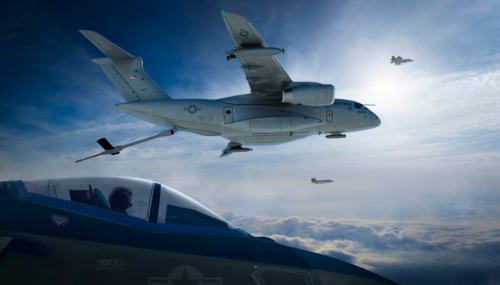
Image: Embraer
The announcement, made from Melbourne, Florida, signals a shift from courtship to commitment. The two companies say they will jointly invest in evolving the KC-390 platform, with a specific focus on delivering a boom-based aerial refueling capability that the aircraft currently lacks, a gap long cited as the key obstacle to winning U.S. military interest.
What the Deal Covers
At the center of the collaboration is a plan to outfit the KC-390 with an advanced autonomous aerial refueling boom, a capability the aircraft does not currently have in operational service. The existing platform refuels other aircraft through underwing hose-and-drogue pods, which limits the range of receiver aircraft it can support. A boom system would allow the KC-390 to service the bulk of the U.S. Air Force’s tactical and strategic jets.
Beyond the boom, the companies say the upgraded KC-390 will feature enhanced communications, improved situational awareness, survivability options suited to contested environments, and adaptable mission systems, all aimed at making the aircraft a credible option for agile combat employment, a concept the Air Force has been pushing as a core pillar of its operational doctrine.
Northrop Grumman brings to the table its expertise in systems integration and its experience with aerial refueling technology. Embraer contributes the airframe itself, a jet-powered medium airlifter that already counts 42 orders globally and is in operational service with Brazil, Portugal, and Hungary.
Tom Jones, Corporate Vice President and President of Northrop Grumman Aeronautics Systems, framed the partnership around listening to allied customers who want more operational independence. “We’re exploring new technologies that will increase the versatility of the proven KC-390 platform and deliver that greater operational independence our customers need,” he said.
Bosco da Costa Junior, President and CEO of Embraer Defense & Security, was direct about the target audience. “The KC-390 is an operationally proven and cost-effective platform that could quickly be added to the U.S. Air Force inventory,” he said. “Together, we will leverage the strengths of two leaders in the defense industry, with a focus on developing a boom refueling system for the KC-390 Millennium.”
A Long Road to This Moment
The Northrop Grumman deal is not Embraer’s first attempt to build a U.S. partnership around the KC-390. In September 2022, the company announced a similar arrangement with L3Harris Technologies, which at the time drew considerable attention. Under that agreement, L3Harris would have served as the prime contractor, with the partnership eyeing a purpose-built refueling boom, resilient communications to support JADC2 requirements, and final assembly on U.S. soil at L3Harris’s facility in Waco, Texas.
The arrangement made strategic sense on paper. L3Harris was an established Pentagon prime with missionization experience, and the partnership offered Embraer a credible path into the U.S. market via an American company. But interest on the L3Harris side appears to have eroded over the following two years, and by October 2024 the alliance had quietly collapsed.
“I think it’s fair to say that the L3 partnership is not there anymore for the agile tanker,” da Costa told Breaking Defense at the time. “They decided not to move on [it] because of other priorities.” L3Harris declined to comment publicly.
Rather than step back, Embraer doubled down. The company conducted a promotional tour of the United States with a Brazilian Air Force KC-390, taking the aircraft to sites in Nevada, Florida, and Maryland, including a visit to Joint Base Andrews, to demonstrate the platform’s capabilities to both government and private sector stakeholders. The company also responded to the Air Force’s request for information on the Next Generation Air Refueling System, or NGAS, and da Costa met with U.S. Defense Secretary Pete Hegseth on the sidelines of the Shangri-La Dialogue in Singapore.
“We are doing our homework, to become a partner of the US government,” da Costa said in June 2025, when he first named Northrop Grumman publicly as a prospective partner. At that point the discussions were still, in his words, “in an early stage.” Eight months later, they resulted in a formal announcement.
The Gap Embraer Is Trying to Fill
The backdrop to all of this is a U.S. Air Force tanker fleet under growing pressure. The service’s aging KC-135 Stratotankers, aircraft that in many cases predate the pilots flying them, need replacing, and the path forward has shifted more than once. The Air Force abandoned its earlier three-pronged KC-X, KC-Y, and KC-Z recapitalization strategy in favor of a more streamlined approach: a near-term limited buy of off-the-shelf tankers to address the KC-135 gap, followed by the longer-term NGAS program.
That opening is what Embraer has been working to exploit. The KC-390 already complies with the Buy American Act due to a high proportion of U.S.-sourced content, and the company has signaled it would establish a stateside final assembly line to deepen its American industrial footprint. Embraer already assembles its A-29 Super Tucano light attack aircraft in Jacksonville, Florida, for foreign military sales customers, giving it a template to work from.
On the allied side, the KC-390 already has a foothold. Hungary and Portugal operate the platform, and Embraer recently signed a service agreement to support the Hungarian Air Force’s fleet. A partnership with Northrop Grumman could accelerate interest among other NATO members and partner nations seeking greater logistical autonomy without the price tag of larger, heavier tankers.
Hurdles Remain
Not everyone is convinced the KC-390 can clear the bar the Air Force has set. Tim Walton, a senior fellow at the Hudson Institute, told Breaking Defense in late 2024 that the aircraft faces structural challenges in the U.S. market. On the airlift side, it competes against the deeply embedded C-130J, which benefits from decades of infrastructure, training pipelines, and institutional familiarity. On the tanking side, Walton noted that the KC-390 carries relatively modest fuel offload capacity compared to the KC-46 and many of the other platforms being considered for NGAS.
Walton also flagged the aircraft’s radar signature as a potential concern relative to other NGAS candidates. His assessment was pointed: for the KC-390 to compete seriously in the KC-135 recapitalization program, the Air Force would likely need to revise the performance parameters it has been working toward. “I do not think it would offload enough fuel at relevant radii to meet desired performance parameters,” he said, though he acknowledged the aircraft could address niche mobility missions and complement the existing C-130 and C-17 fleets. In a statement to Aviation Week, Northrop Grumman says the partnership with Embraer will allow both parties “to deliver a non-developmental, multi-mission tactical refueling solution for the U.S. Air Force and others.”
Embraer’s Larger Play
The KC-390 partnership is part of a broader ambition that Embraer has been articulating with increasing confidence. The company has made clear it wants to be more than a foreign vendor selling into the U.S. market. It wants to be recognized as an American industrial partner, with manufacturing jobs, U.S. content, and long-term program relationships to show for it.
Da Costa has said the company is exploring a range of structures for its U.S. expansion, including going it alone as a prime contractor, partnerships like the one now struck with Northrop Grumman, and even mergers and acquisitions. “Embraer is in a serious way trying to become a defence player in the US,” he said last year, “and with a serious plan to invest and open an assembly line in the US.”
Pairing with Northrop Grumman, one of the five largest defense contractors in the United States, gives that ambition considerably more institutional credibility than it had when Embraer was exploring the market alone after the L3Harris split.
What Comes Next
The two companies have not disclosed a development timeline, contract structure, or investment figures. What they have committed to is joint funding and a shared focus on rapid capability delivery, language that signals both sides are serious about moving at pace rather than treating this as a study program.
The real test will come as Air Force procurement decisions crystallize. The KC-135 recapitalization has largely been viewed as a contest between Boeing and Airbus, the two established heavyweights in large tanker production. But Embraer has consistently argued that the conversation should be broader than that, that there is a niche, and perhaps more, for a smaller, faster, more agile tanker that can operate from austere forward locations where a KC-46 cannot go.
“What we are trying to fill is a gap that the US Air Force has now with a plane that it’s ready,” da Costa said. “To add capabilities now.” With Northrop Grumman now formally alongside them, Embraer at least has a stronger hand to make that argument.
For more information, hit the Source below