South Korea is preparing for intense negotiations over military alliance costs during President Lee Jae-myung’s upcoming Washington summit with U.S. President Donald Trump, with Boeing’s KC-46 aerial refueling aircraft potentially playing a key role in the discussions after a recent trade deal deliberately sidestepped the contentious defense funding issue.
With just two weeks until Lee’s White House visit, defense officials are scrambling to prepare proposals that could satisfy Trump’s demands for increased burden-sharing without compromising South Korea’s strategic interests. At stake: billions of dollars in U.S. military support that helps defend Seoul from North Korean threats, plus the broader future of the seven-decade alliance.
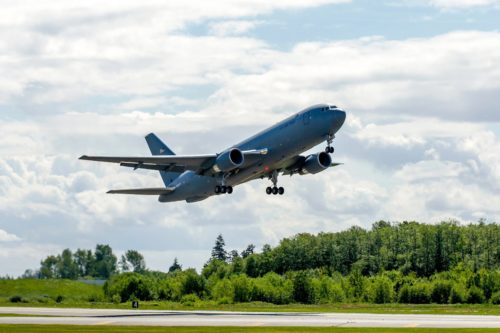
Trump’s threat to withdraw U.S. troops unless South Korea pays more for their deployment during his first term has created urgent pressure for Seoul to demonstrate commitment through tangible military investments. The KC-46 aerial refueling aircraft procurement has emerged as a potential centerpiece of South Korea’s diplomatic strategy, helping demonstrate the country’s commitment to supporting American defense manufacturers.
The timing poses particular challenges for Seoul, which just committed $350 billion in U.S. investments as part of last week’s trade agreement that secured a 15% tariff rate. Of that sum, $150 billion was earmarked for shipbuilding projects including warships, leveraging South Korea’s world-leading maritime construction capabilities to address U.S. naval decline.
However, the trade deal’s success in avoiding higher tariffs has only intensified scrutiny on the unresolved military cost-sharing arrangement. Trump’s previous administration repeatedly criticized allies for not paying their “fair share” for U.S. security guarantees, a theme that has returned with renewed vigor.
The potential KC-46 deal represents a strategic pivot from South Korea’s 2019 decision to select the European Airbus A330 MRTT for its first-phase refueling aircraft program. Seoul chose the European option partly because Boeing’s KC-46 development remained incomplete, raising questions about delivery timelines and technical maturity.
The geopolitical landscape has shifted considerably since then. Trump’s return to the presidency has revived concerns about his administration’s use of economic pressure to secure favorable defense purchases from allies. During his previous term, Trump frequently criticized allies for inadequate defense spending while purchasing equipment from American competitors.
The KC-46 purchase could serve multiple strategic purposes beyond addressing alliance cost concerns. The South Korean Air Force is already preparing a second-phase project to acquire two aerial refueling aircraft by 2030, making the KC-46 a natural candidate for consideration.
The aircraft would enhance Seoul’s military capabilities in the increasingly contested Indo-Pacific region, where aerial refueling capacity proves crucial for extended operations. The purchase would also demonstrate tangible support for the U.S.-South Korea alliance while both nations face security challenges from North Korea and China.
The aircraft’s technical capabilities have improved significantly since South Korea’s initial evaluation. Boeing has resolved many early development issues that plagued the KC-46 program, and the aircraft now operates with the U.S. Air Force.
For Boeing, a South Korean order would provide welcome momentum for the KC-46 program, which has faced cost overruns and technical challenges during development. International sales help spread fixed development costs across a larger customer base and create additional opportunities for maintenance and upgrade contracts over the aircraft’s operational lifetime.
Unlike the trade negotiations, where South Korea successfully avoided crossing red lines on agricultural market access, the military cost-sharing talks may require more substantial concessions. The presence of approximately 28,500 U.S. troops on the Korean Peninsula represents both a security guarantee and a potential bargaining chip in Trump’s diplomatic toolkit.
President Lee’s administration faces domestic political challenges in justifying increased military spending, particularly following substantial investment commitments made during trade negotiations. The National Assembly maintains oversight over major defense purchases and has previously expressed concerns about cost escalation in military programs. The KC-46’s price point and long-term operational costs will likely face scrutiny from budget-conscious legislators.
The shipbuilding component of the recent trade deal provides a potential template for military discussions. By leveraging South Korea’s industrial strengths to address American strategic weaknesses, Seoul demonstrated how burden-sharing arrangements can benefit both partners while advancing shared security objectives.
For more information, hit the Source below