China publicly displayed its JingLei-1 (JL-1) nuclear-armed air-launched ballistic missile for the first time during the Victory Day parade in Beijing on September 3, marking a significant milestone in the development of the country’s nuclear triad capabilities. The parade commemorated the 80th anniversary of the Allied victory in World War II.
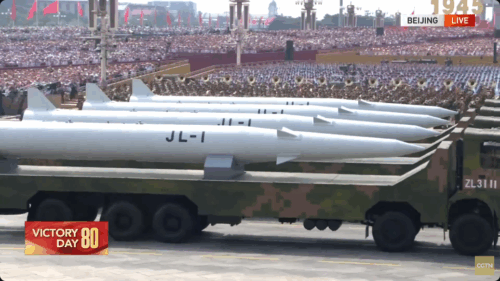
The JL-1 represents the air-launched component of China’s expanding nuclear arsenal and is carried aboard the H-6N bomber platform. The missile’s public debut provides the first official confirmation of capabilities that defense analysts have been tracking since the H-6N bomber’s initial appearance in 2019.
According to the Pentagon’s annual report on Military and Security Developments Involving the People’s Republic of China, the H-6N bomber is a derivative of the H-6K specifically optimized for long-range strikes. The aircraft features a recessed underside that enables it to carry the air-launched ballistic missile externally. These structural changes, combined with the addition of an air-to-air refueling probe, substantially extend the platform’s operational range compared to non-refuelable H-6 variants.
The Pentagon assessment indicates that the ALBM carried by the H-6N appears to be equipped with a maneuvering reentry vehicle, suggesting advanced precision strike capabilities. Defense officials believe the weapon system can conduct nuclear precision strikes against targets throughout the Indo-Pacific theater, placing it in the same strategic category as China’s DF-26 intermediate-range ballistic missile.
The development timeline for this capability spans several years of incremental progress. The H-6N bomber made its first public appearance during China’s 70th anniversary parade in 2019, though at that time no missile was displayed. An H-6N carrying an ALBM during flight testing was observed at Neixiang Air Base, Henan province in October 2020. The People’s Liberation Army Air Force operationally fielded the H-6N bomber platform that same year.
The JL-1’s introduction completes the air component of China’s nuclear triad, joining land-based intercontinental ballistic missiles and submarine-launched ballistic missiles. This development represents a significant enhancement to China’s strategic deterrent posture, as air-launched systems provide greater flexibility and survivability compared to fixed ground-based installations.
From a regional security perspective, the weapon system’s assessed range and precision capabilities raise important questions about the changing military balance in the Indo-Pacific. The combination of the H-6N’s extended range through air-to-air refueling and the JL-1’s precision strike capability potentially places critical infrastructure and military installations across the region within reach of Chinese nuclear forces.