On Feb. 16, a German Navy P-8A Poseidon maritime patrol aircraft lifted off from Nordholz Naval Air Base on Germany’s North Sea coast and headed east. It was bound for India on the first intercontinental deployment of its kind.
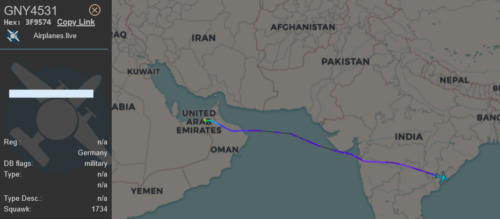
Flight tracking data showed that the plane arrived in India on Feb. 18, after taking off from Al Dhafra airbase in the United Arab Emirates.
The deployment is part of the German Navy’s Indo-Pacific Deployment 2026, an annual exercise in strategic presence that has become a fixture of German foreign and defense policy in recent years. This year, for the first time, the Navy is sending its newest maritime reconnaissance aircraft along for the journey. The Poseidon participated in India’s International Fleet Review, held in Visakhapatnam beginning Feb. 18, where Indian President Droupadi Murmu reviewed an assembled fleet representing more than 70 nations. Germany’s participation, alongside first-time deployments by the Philippines and the UAE, added a layer of diplomatic weight to what was already one of the largest naval gatherings India has ever hosted.
Germany’s investment in the P-8A has been gradual but deliberate. In 2021, following the retirement of the P-3C Orion and a period during which the Bundeswehr had no viable long-range maritime patrol capability, the Federal Ministry of Defence announced the purchase of five Poseidons at a cost of €1.1 billion through the U.S. Foreign Military Sales process. The acquisition was described at the time as an interim solution — intended to cover the capability gap until a longer-term successor could be developed through the German-French Maritime Airborne Warfare System program. Then in November 2023, Germany’s parliamentary Budget Committee approved funding for three additional aircraft at a further cost of just under €1.1 billion, drawn from the Bundeswehr’s special defense fund. That brings the total fleet to eight aircraft, with a dedicated simulator for crews also approved as part of the broader program.
Preparations for the current deployment began months before the aircraft ever left the tarmac. The Marinefliegergeschwader 3 “Graf Zeppelin” — the squadron responsible for the mission — put crews through extensive flight training and mission planning exercises, while maintenance personnel worked to ensure the aircraft was ready for a long-haul flight and operations in a climatically demanding environment. Spare parts, ground equipment, and mission-specific gear were assembled and staged well in advance. Getting a modern, complex maritime patrol aircraft halfway around the world without a hitch requires exactly this kind of painstaking groundwork, and the German Navy made a point of emphasizing how closely its flight, technical, and logistics personnel worked together to make it happen.
From India, the Poseidon will operate across the broader Indo-Pacific region. The planned activities include reconnaissance and presence flights as well as participation in bilateral and multinational exercises.
According to the German Navy, the deployment serves three core purposes: deepening ties with regional partners, contributing to the security of sea lanes and trade routes, and demonstrating that Germany remains a reliable partner in the Indo-Pacific even as it manages the demands of the war in Ukraine on its doorstep.
For more information, hit the Source below