GA-ASI and the U.S. Air Force conducted a manned-unmanned teaming demonstration at Edwards Air Force Base recently that marked a notable step forward in the service’s pursuit of autonomous wingman capability, and the second time in four months that an F-22 Raptor and an MQ-20 Avenger have shared the same airspace as a coordinated team.
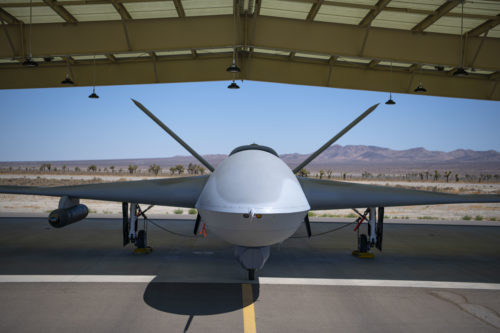
The exercise, run out of Edwards in Southern California, had the MQ-20 executing an autonomous mission alongside an F-22 equipped with the latest government reference autonomy software. Unlike previous industry-led experiments, this one had the Air Force as an active partner, a distinction that speaks to where this technology stands in its maturation.
“We appreciate the flawless execution of this mission using the government’s advanced autonomous systems,” said GA-ASI President David R. Alexander. “This demo featured the integration of mission elements and the ability of autonomy to utilize onboard sensors to make independent decisions and execute commands from the F-22.”
The MQ-20 received commands through the Autonodyne Bashi Pilot Vehicle Interface aboard the F-22, responding to directions from a human pilot in the cockpit. Those commands drove the unmanned jet through tactical maneuvers, waypoint adjustments, Combat Air Patrol tasks, and what the company described as airborne threat engagement. The drone wasn’t just flying alongside; it was taking orders and acting on them.
A Foundation Built in November
To understand what February’s exercise represented, it helps to look back at what happened over the Nevada desert three months earlier.
On Oct. 21, 2025, GA-ASI teamed with Lockheed Martin and L3Harris Technologies for a different kind of F-22/MQ-20 demonstration, one focused not on what the aircraft could do together, but on whether they could reliably talk to each other in the first place. That flight, conducted at the Nevada Test and Training Range, integrated L3Harris’ BANSHEE Advanced Tactical Datalinks and Pantera software-defined radios through Lockheed Martin’s open radio architecture, with both the F-22 and MQ-20 each carrying one of the SDRs. A Pilot Vehicle Interface tablet and the F-22’s GRACE module tied the system together, giving the Raptor pilot end-to-end command and control of the unmanned jet.
Critically, that November exercise was funded through internal research and development budgets, the companies’ own money, not a government contract. GA-ASI described it at the time as part of an ongoing series of demonstrations aimed at showcasing “the art of the possible.” The communications architecture it validated was non-proprietary and government-owned, which was a deliberate choice, signaling the industry partners were building toward a transferable capability rather than a proprietary solution they would own outright.
That context matters. November was about proving the plumbing worked. February was about what you can do once it does.
Two Exercises, One Trajectory
The differences between the two demonstrations are instructive. The November flight was an industry consortium effort, three companies pooling resources to prove out an interoperability concept on their own dime. The February exercise brought the Air Force in as a direct collaborator, used government reference autonomy software, and pushed into operational territory with live engagements and tactical command execution. The location shifted too, from the Nevada Test and Training Range to Edwards, the Air Force’s primary flight test center.
The pilot interface also changed between the two flights. November used L3Harris’ Pantera radio system interfaced through the F-22’s existing GRACE module. February employed the Autonodyne Bashi interface for issuing autonomy commands. The underlying communications layer and the autonomy stack are separate problems, and the progression from one exercise to the next reflects that logic plainly: solve communications first, then layer autonomous behavior on top.
What stayed constant across both flights was the aircraft pairing itself. GA-ASI has used the MQ-20 Avenger as a surrogate Collaborative Combat Aircraft for more than five years, and the Raptor has emerged as the natural crewed counterpart for these tests. The F-22 is not the Air Force’s newest fighter, but its performance envelope and sensor suite make it a relevant testbed for the kinds of high-end missions where CCAs would actually earn their keep.
The CCA Surrogate Grows Up
GA-ASI is careful to note that the MQ-20 was always a stand-in. The company now has purpose-built CCA platforms in development, the XQ-67A and the YFQ-42A, that have been flying since GA-ASI expanded its unmanned portfolio. The Avenger’s long run as a surrogate has generated a substantial body of operational data and test experience that will feed directly into those newer programs.
The February demonstration highlighted what the Pentagon has framed as the central promise of CCAs: the ability to act as force multipliers for crewed platforms. Rather than replacing the pilot, the autonomous wingman extends what that pilot can do, covering more airspace, taking on higher-risk tasks, and responding to commands faster than a human-to-human coordination loop would allow.
For more information, hit the Source below