Indonesia’s Air Force took delivery of two South Korean-made T-50i trainer jets, according to a report by ANTARA News in February. The aircraft, part of a six-aircraft purchase from Korea Aerospace Industries (KAI), were sent to Iswahjudi Air Base in Madiun, East Java. The delivery was subsequently confirmed by South Korean logistics firm CJ Logistics in a press release, which shed light on the complex operation behind the shipment.
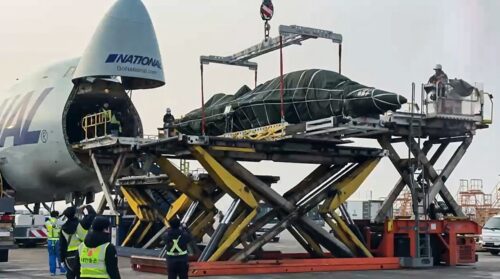
Photo: CJ Logistics
The delivery drew unexpected public attention after videos circulated on social media showing large aircraft components being transported separately on trucks to the air base, some wrapped in black protective sheeting.
Indonesian Defense Ministry spokesperson Brigadier General Rico Ricardo Sirait explained that the delivery method complied with applicable standards and would not affect the aircraft’s quality or operational performance. “We emphasize that all logistics and transfers of defense equipment are conducted through official, secure mechanisms in accordance with prevailing regulations,” he said.
The disassembly was, in fact, by design. CJ Logistics used what it describes as a modular approach, breaking each aircraft down into four core components: the fuselage, wings, vertical tail fin, and engine. The parts were shipped separately and reassembled upon arrival at the air base.
Moving two 30-ton trainer jets across borders required considerable planning. CJ Logistics conducted detailed road surveys to map out safe transport corridors, accounting for bridge heights, turning radii, and road conditions both in South Korea and Indonesia. Vibration-free vehicles fitted with air suspension systems were used for the ground legs of the journey — roughly 530 kilometers from KAI’s facility in Sacheon to Incheon Airport in South Korea, and a further 200 kilometers from Juanda Airport, Surabaya to the air base in Indonesia. Vehicles maintained an average speed of 60 kilometers per hour throughout.
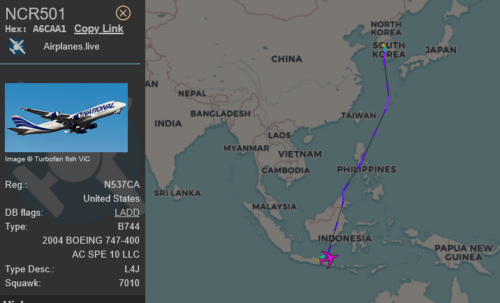
The air routing also required careful work. Military cargo of this nature can face airspace restrictions depending on the countries along the flight path. CJ Logistics said it drew on its defense logistics experience to identify and clear a viable route passing through four countries, avoiding potential delays from denied overflight permissions. Flight tracking data shows the cargo was carried aboard a National Air Cargo Boeing 747 freighter, registered N537CA, operating as flight NCR501. A photo from CJ Logistics confirmed that one of the aircraft was loaded into a National Air Cargo Boeing 747. The aircraft departed Incheon Airport at approximately 02:04 UTC and touched down at Juanda Airport approximately eleven hours later at 13:00 UTC on Feb. 4. Tracking data shows the flight path took the freighter south along the coast of the Korean peninsula, passing over the Okinawa before skirting the western edge of the Philippines and heading down through Indonesian airspace to its final destination in East Java.
Indonesia’s tropical monsoon climate added another layer of complexity. Custom waterproof covers were prepared for each component to protect against rain damage during ground transport and it is likely these covers that appeared in the viral social media videos. What many viewers interpreted as suspicious black sheeting was in fact standard protective wrapping designed to shield sensitive aircraft components from the elements during the final stretch of the journey to the air base.
The two jets are part of a contract for six T-50i advanced trainer aircraft ordered from South Korea to strengthen the Air Force’s pilot training and light combat capabilities. Indonesia already operates 13 T-50 with its 15th Air Squadron, also based at Iswahjudi Air Base. Three aircraft from the original order of 16 jets were lost to accidents.
The T-50i delivery arrives at an interesting moment, as the aircraft’s days as Indonesia’s primary advanced jet trainer may already be numbered. At the Singapore Airshow in February 2026, Italian defense firm Leonardo announced it had signed a Letter of Intent with Indonesia’s Ministry of Defence and local partner PT ESystem Solutions for the supply of its M-346F “Block 20” aircraft. The deal is aimed at meeting the Indonesian Air Force’s training and combat requirements, and is expected to contribute to a broader fleet modernization plan that includes replacing ageing aircraft such as the Hawk. The agreement also covers maintenance, overhaul, and training support to be localized within Indonesia.
With the M-346F expected to take over the roleof training next-generation Indonesian fighter pilots, the T-50i’s tenure in that capacity looks to be drawing to a close and the Korean-made aircraft is expected to soldier on as a light attack fighter aircraft in Indonesia. The T-50i is expected to work alongside with Indonesia’s F-16 fleet, which are also bed down at Iswahjudi Air Base, and tap into existing weapon stocks from the F-16 for its new role in future.
For more information, hit the Source below