457th EFS marks historic milestone with final F-16 deployment

In a poignant moment marking the end of an era, the 457th Expeditionary Fighter Squadron (EFS) recently concluded its overseas deployment with the F-16C “Fighting Falcon” aircraft. This deployment holds special significance as it marks the squadron’s final mission with the venerable aircraft before embarking on an exciting transition to the cutting-edge F-35.


U.S. Air Force photo by Tech. Sgt. Alexander Frank
Continue reading “457th EFS marks historic milestone with final F-16 deployment”

VMU-3 attains initial operational capability with MQ-9A

Marine Unmanned Aerial Vehicle Squadron (VMU) 3 marked a significant achievement as they reached Initial Operational Capability (IOC) with the MQ-9A Extended Range Marine Air-Ground Task Force (MAGTF) Unmanned Expeditionary (MUX) Medium-Altitude, High-Endurance (MALE) aircraft. In a unit-led ceremony, VMU-3 commemorated their years of dedicated effort and introduced the operational MQ-9A to Marines, family members, and distinguished guests.

The U.S. Marine Corps MQ-9A MUX/MALE is formally unveiled during a ceremony for Marine Unmanned Aerial Vehicle Squadron 3 (VMU-3), Marine Aircraft Group 24, 1st Marine Aircraft Wing at Marine Corps Air Station Kaneohe Bay, Aug 2, 2023. The ceremony commemorated the squadron’s years of dedicated effort and work to reach Initial Operational Capability with the MQ-9A. VMU-3 can support the Marine Air-Ground Task Force by providing multi-surveillance and reconnaissance, data gateway and relay capabilities, and enabling or conducting the detection and cross cueing of targets and facilitating their engagement during expeditionary, joint and combined operations.(U.S. Marine Corps photo by Cpl. Christian Tofteroo)

Continue reading “VMU-3 attains initial operational capability with MQ-9A”

Automated mission upgrades: B-2 IAMT system’s game-changing demonstration

Northrop Grumman, in collaboration with the U.S. Air Force, achieved a significant milestone by successfully showcasing an innovative Integrated Airborne Mission Transfer (IAMT) system for the B-2 Spirit bomber. This achievement took place during a two-day demonstration event held at Whiteman Air Force Base, Missouri, last month. The IAMT system, part of Northrop Grumman’s B-2 Collaborative Combat Communication (B2C3) Spiral 1 program, marks a pivotal advancement in the ongoing modernization efforts that center around the application of digital engineering.

U.S. Air Force B-2 Spirit bombers assigned to the 509th Bomb Wing, Whiteman Air Force Base, Missouri, conduct off-station training Nov. 15, 2022, at Luke Air Force Base, Arizona. This was the first time that allied nation F-35 Lightning II aircraft integrated with U.S. Air Force B-2’s in the United States. (U.S. Air Force photo by Airman 1st Class Jakob Hambright)

Continue reading “Automated mission upgrades: B-2 IAMT system’s game-changing demonstration”

Google’s SandboxAQ and USAF collaborate for quantum navigation

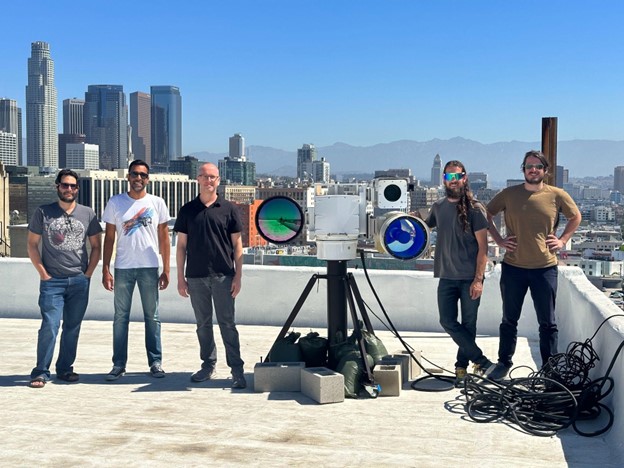
In a bid to overcome the challenges posed by GPS-denied environments during military operations, the U.S. Air Force (USAF) has enlisted the innovative prowess of SandboxAQ. A derivative of Google’s parent company, Alphabet, SandboxAQ specializes in harnessing the combined power of quantum science and artificial intelligence (AI) to address complex global challenges. Together with the USAF, they are embarking on a transformative journey to revolutionize navigation capabilities for aircrew members.


Photo: USAF

Continue reading “Google’s SandboxAQ and USAF collaborate for quantum navigation”

Japan explores equiping its C-2 with Rapid Dragon-like capability

In a bid to bolster its standoff defense capabilities, Japan’s Defense Ministry is contemplating equipping C-2 transport planes of the Japan Air Self-Defense Force with long-range missiles, as reported in a recent government announcement. The addition of these missiles could significantly improve Japan’s ability to conduct counterstrike operations by targeting enemy bases, including missile launch sites, from a safer distance.

Once the Palletized Munition Deployment System was stabilized under the parachutes, the production long range cruise missile STV and mass simulants were released sequentially, timed for safe separation between munitions. The photo shows a successful separation of a STV from the sabot following the weapon release, followed by the deployment of the STV’s control surfaces (wings and tail). (Courtesy photo)

Continue reading “Japan explores equiping its C-2 with Rapid Dragon-like capability”