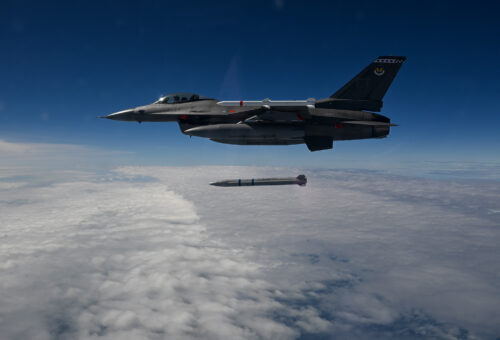
The U.S. Air Force successfully released its new Stand-in Attack Weapon (SiAW) from an F-16 over the Gulf of Mexico on Nov. 7. The test, involving a jettison test vehicle (JTV), marked the first time the SiAW separated from an aircraft. The JTV lacked a rocket motor and internal electronics, focusing solely on the weapon’s safe separation from the aircraft.
A 40th Flight Test Squadron F-16 Fighting Falcon releases a Stand-in Attack Weapon for the first time Nov. 7 at Eglin Air Force Base, Florida. The mission marked the first time the weapon was successfully released from an aircraft. (U.S. Air Force photo by Staff Sgt. Blake Wiles) Continue reading “SiAW cores first flight test milestone”
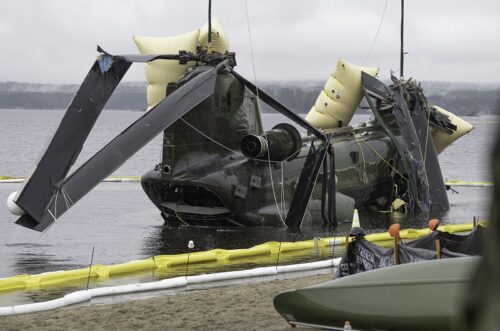
A Royal Canadian Air Force (RCAF) CH147F Chinook helicopter, tail number CH147310, crashed into the Ottawa River on the night of Jun. 19, 2023, killing two pilots. The accident occurred during a demanding night training exercise designed to challenge student pilots as part of the Tactical First Officer Course. The newly released accident report concludes that the crew experienced spatial disorientation, leading to a Controlled Flight into Terrain (CFIT).
The U.S. Air Force is temporarily relocating 17 B-1B Lancer bombers and 800 airmen from Ellsworth Air Force Base, South Dakota, to Grand Forks Air Force Base, North Dakota. This marks the return of the B-1 to Grand Forks after 30 years. The move is necessary to allow for runway construction at Ellsworth AFB in preparation for the arrival of the new B-21 Raider.
U.S. Air Force B-1B Lancer assigned to the 28th Bomb Wing lands for a refueling at Grand Forks Air Force Base, N.D., September 29, 2024. The bomber arrived at Grand Forks AFB in preparation for the jet’s temporary relocation to the base to continue flying operations while the flightline at Ellsworth Air Force Base undergoes reconstruction. (U.S. Air Force photo by Airman Emma Funderburk) Continue reading “B-1s to touch down in Grand Forks for 10-month stay”
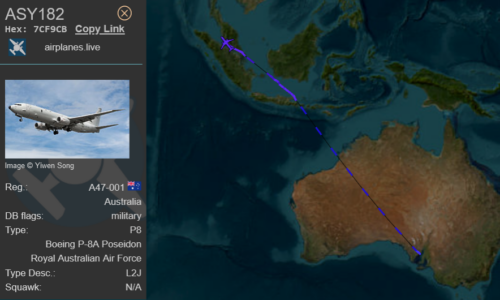
The Royal Australian Air Force (RAAF) has once again sent two of its P-8A Poseidon maritime patrol aircraft to Royal Malaysian Air Force (RMAF) Base Butterworth. This deployment is part of Operation Gateway, Australia’s longest-running defence operation. Flight tracking data from airplanes.live reveals that the two aircraft touched down in Malaysia on Nov. 23.
The U.S. Air Force will begin replacing Misawa Air Base’s 36 Lockheed Martin F-16s with 48 F-35As in the spring of 2026, according to the Japanese Ministry of Defense. The service plans to start phasing out the F-16s in the summer of 2025. The move comes as part of the Pentagon’s plan to modernise US airpower in the Indo-Pacific.
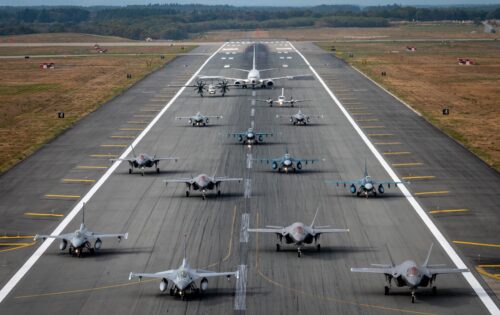
Four U.S. Air Force F-16 Fighting Falcons, four Japan Air Self-Defense Force (JASDF) F-35A Lightning II Joint Strike Fighters, four JASDF F-2s, one JASDF E-2D Hawkeye, one U.S. Navy C-12 Huron, and one U.S. Navy P-8 Poseidon perform a wing capabilities demonstration in support of Keen Sword 25 at Misawa Air Base, Japan, Nov. 1, 2024. The U.S.-Japan alliance is built on shared interests, values and a commitment to freedom and human rights; the alliance is strong and focused on enhancing a security architecture of regional partnerships. (U.S. Air Force photo by Kohei Sugisawa) Continue reading “U.S. Air Force to replace Misawa F-16s with F-35As”