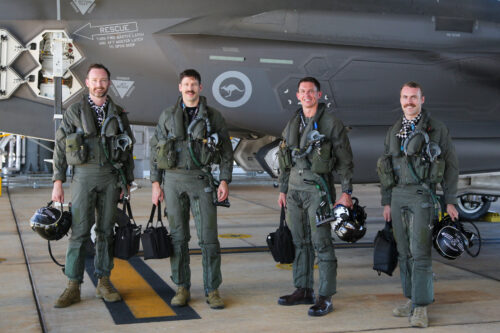
In June 2024, during a joint training exercise at RAAF Base Tindal, Australia, two United States Marine Corps (USMC) F-35B pilots from Marine Fighter Attack Squadron (VMFA) 214 successfully flew Royal Australian Air Force (RAAF) F-35A aircraft. This accomplishment signifies a significant step towards interchangeable operations between the two forces.
From left, Royal Australian Air Force Flight Lieutenant Stuart Atkin, an F-35A Lightning II pilot with the RAAF No. 75 Squadron; RAAF Squadron Leader Brett Gordon, an F-35A Lightning II pilot with the RAAF No. 75 Squadron; U.S. Marine Corps Maj. John Rose, an F-35B Lightning II pilot and executive officer of Marine Fighter Attack Squadron (VMFA) 214, Marine Aircraft Group 13, 3rd Marine Aircraft Wing; and RAAF Flight Lieutenant Nicholas Ebzery, an F-35A Lightning II pilot with the RAAF No. 75 Squadron, pose for a picture after a flight at RAAF Base Tindal, Northern Territory, Australia, June 13, 2024. Leaders with VMFA-214, a USMC F-35B squadron, flew the RAAF F-35A during bilateral training, exhibiting interchangeability between RAAF and U.S. Marine aviation. VMFA-214 deployed more than 200 Marines and eight F-35B Lightning II aircraft from Marine Corps Air Station Yuma, Arizona, to RAAF Base Tindal, Australia, to conduct bilateral training with the RAAF No. 3 Squadron and No. 75 Squadron. (U.S. Marine Corps photo by Cpl. Nicholas Johnson)
The U.S. Marine Corps’ MQ-9A Reaper drone fleet appears to be gaining a new edge in low-observability technology. During a recent event at the Brookings Institution, General Eric M. Smith, the 39th commandant of the Marine Corps, alluded to a classified pod system called T-SOAR that enhances the drone’s ability to evade enemy radar detection.
California Air National Guard’s 144th Fighter Wing (144 FW) recently hosted Marine Fighter Attack Squadron 211 (VMFA-211) for a joint training exercise focused on fighter integration. The F-35B Lightning IIs from Arizona arrived at Fresno Air National Guard Base on Jun. 7th, to train alongside the 144th FW’s F-15C Eagle fighter jets.
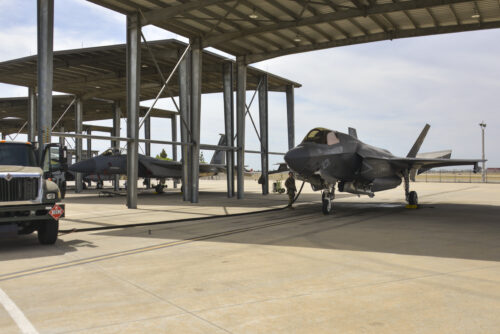
An F-35B Lightning II is refueled on the flightline of the Fresno Air National Guard Base, California, while parked next to an F-15C Eagle, June 8, 2024. F-35s from Marine Fighter Attack Squadron 211 and F-15s from the 144th Fighter Wing conducted fourth and fifth generation fighter integration training June 7-9, 2024, to refine and sharpen their skills while completing required flight training hours.(U.S. Air National Guard photo by Maj. Jason Sanchez) Continue reading “Air Guard F-15Cs sharpen skills alongside Marine F-35Bs in joint training”
The Royal Australian Air Force (RAAF) has announced that the upcoming Exercise Pitch Black, taking place from Jul. 12th to Aug. 2nd, 2024, will be the largest in its 43-year history. This significant international military exercise will see the participation of the Italian aircraft carrier Cavour, along with its embarked AV-8B Harrier II and F-35B Lightning II fighter jets.
Capt. Raymond Hower, a U.S. Marine Corps AV-8B Harrier pilot with Marine Attack Squadron (VMA) 223, recently conducted a commemorative flight to honor his great-uncle, LCDR Louis A. Conter. Conter, who passed away on Apr. 1st, at the age of 102, held the distinction of being the last known survivor of the USS Arizona during the attack on Pearl Harbor.
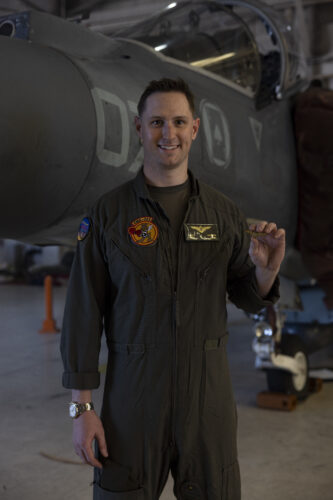
U.S. Marine Corps Capt. Raymond Hower, a native of California and an AV-8B Harrier II jet pilot with Marine Attack Squadron (VMA) 223, poses for a photo holding his great-uncle Louis A. Conter’s naval aviator wing insignia at Marine Corps Air Station Cherry Point, North Carolina, April 18, 2024. Conter was the last known survivor of the USS Arizona during the attack on Pearl Harbor in 1941 and passed away April 1, 2024. Hower flew U.S. flags and Conter’s naval aviator wing insignia during the flight. Conter served in the U.S. Navy from 1939 to 1967. (U.S. Marine Corps photo by Lance Cpl. Orlanys Diaz Figueroa)
_-_Civitavecchia_harbour,_Italy_-_June_2011.jpg)