Delays with the F-35 program has forced the U.S. Marine Corps to bring 30 legacy Hornets out from the 309th Aerospace Maintenance and Regeneration Group (AMARG) facility at Davis-Monthan Air Force Base to cover shortfalls, Jane’s reported.
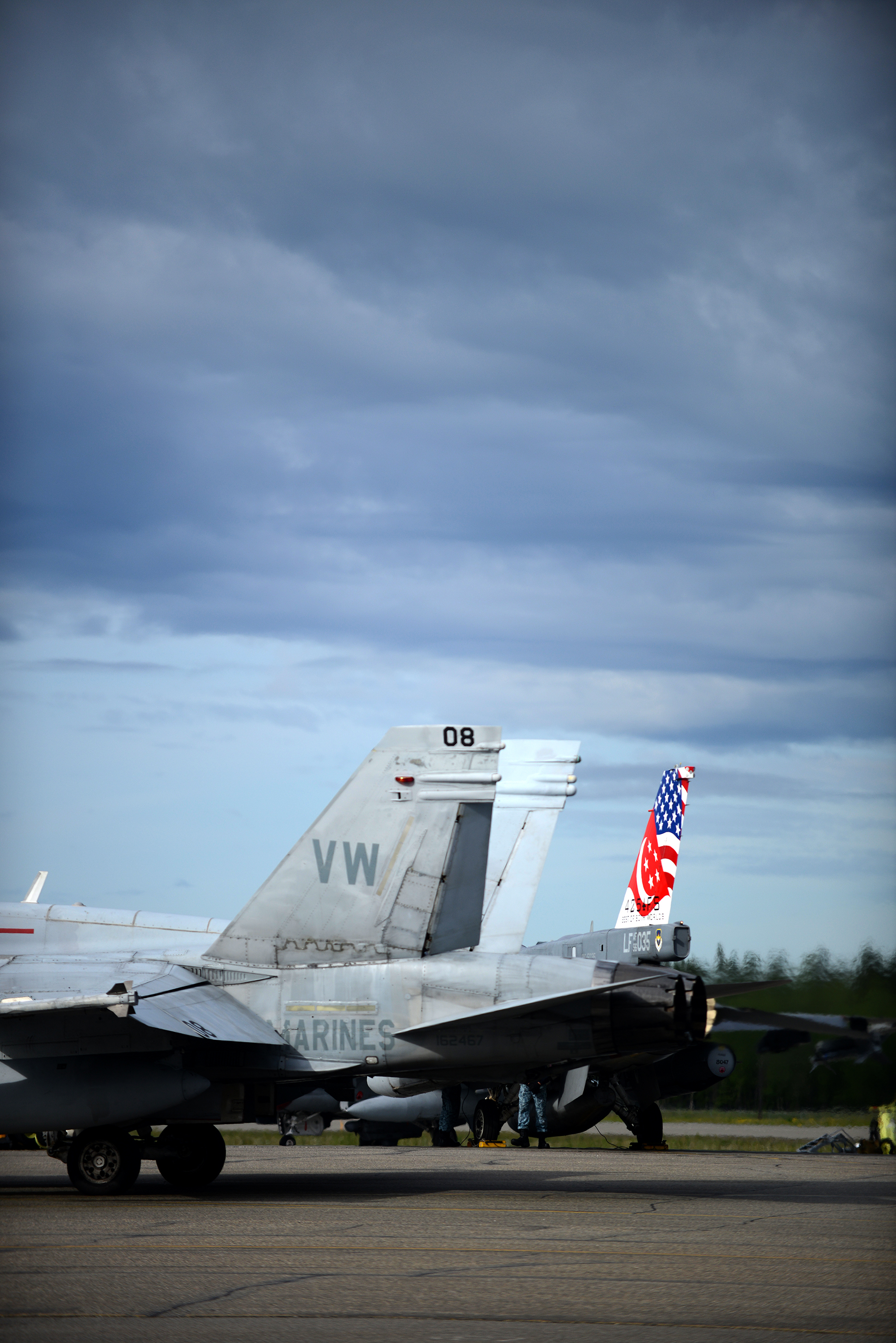
VMFA (AW)-242 and VMFA-314 deployed their F/A-18s and Marines from MCAS Iwakuni, Japan, to Eielson Air Force Base, Alaska, to participate in exercise Red Flag-Alaska 16-2.
A U.S. Marine Corps F-18 Hornet assigned to Fixed Marine All-Weather Fighter Attack Squadron 242, Marine Corps Air Station Iwakuni, Japan, taxis past a Republic of Singapore Air Force F-16 Fighting Falcon, June 7, 2016, during RED FLAG-Alaska (RF-A) 16-2, at Eielson Air Force Base, Alaska. In addition to enabling joint and international units to work side-by-side, RF-A allows coalition forces to exchange tactics, techniques and procedures while improving interoperability. (U.S. Air Force photo by Tech. Sgt. Steven R. Doty) Continue reading “Iwakuni Hornets at Eielson AFB for RF-A 16-2”
The entire U.S. Marine Corps rotary-wing fleet could be converted into autonomous flying machines starting from 2018 if the Autonomous Aerial Cargo/Utility System (AACUS) being develop by Aurora Flight Sciences proves to be workable.
A U.S. Marine Corps CH-46 went down off the coast of Vietnam during Operation Frequent Wind on Apr. 29, 1975. Two pilots on board were killed, making them the last two American military servicemen to die in Vietnam.
The Pentagon on May 26 awarded a $58 million contract to the Bell-Boeing Joint Project Office in order for the latter to develop and integrate the V-22 aerial refueling system for the MV-22.
.jpg)
![160526-M-KA224-111[1]](http://alert5.com/wp-content/uploads/2016/05/160526-M-KA224-1111.jpg)
_c1973.jpg)