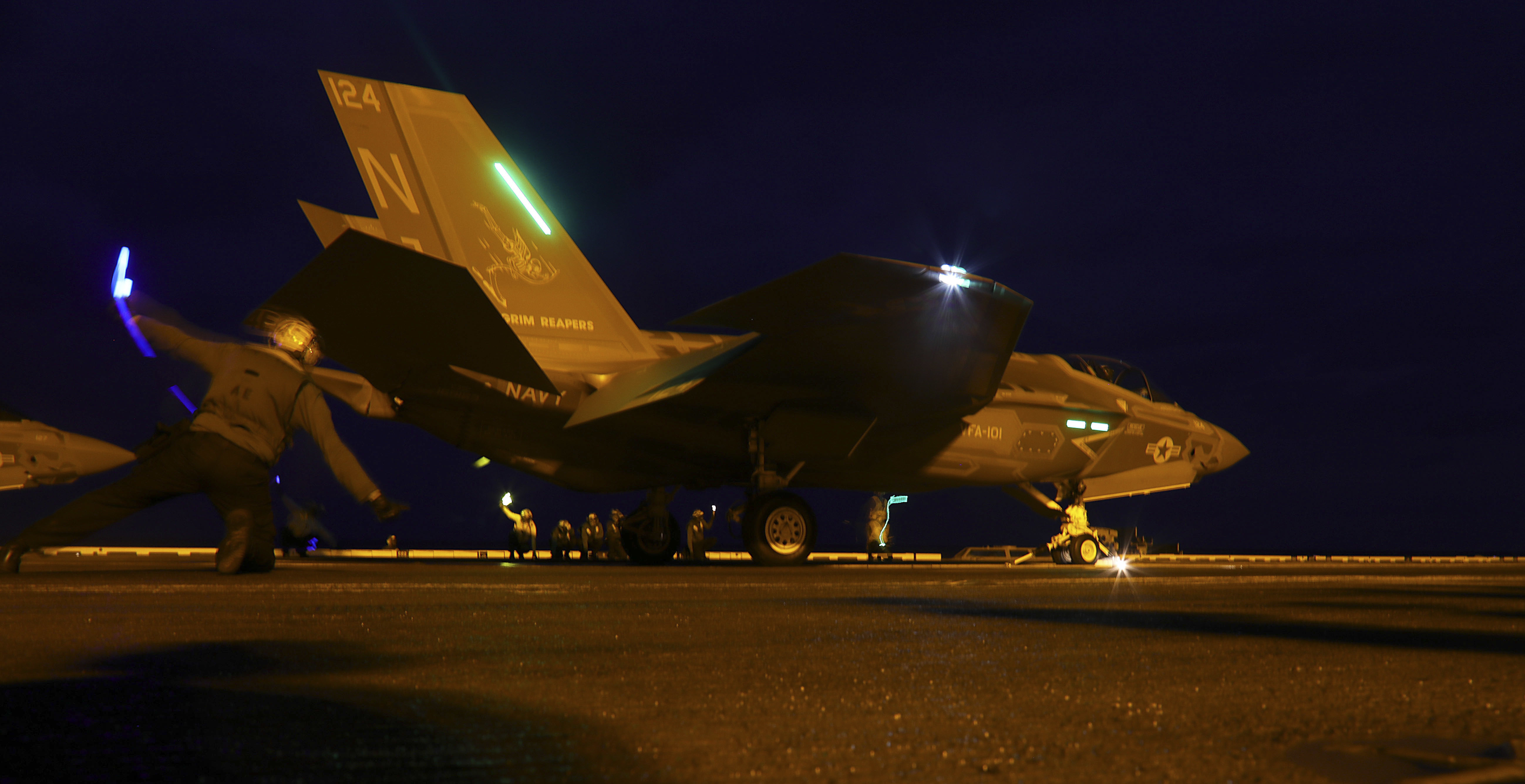
The U.S. House Armed Services Committee has directed the Navy to report back by 2019 on how to “expand the strike range of a carrier air wing in a contested environment.” After concluding that the F-35C’s current range will not allow it to strike enemy targets without putting the carrier in harm’s way.
170907-N-CT127-0021 ATLANTIC OCEAN (Sept. 7, 2017) An F-35C Lightning II assigned to the “Grim Reapers” of Strike Fighter Squadron (VFA 101) prepares to launch from the flight deck of the Nimitz-class aircraft carrier USS Abraham Lincoln (CVN 72). Abraham Lincoln is underway conducting training after its successful completion of carrier incremental availability. (U.S. Navy photo by Mass Communication Specialist 1st Class Josue Escobosa/Released)
The Armenian Ministry of Defense has disclosed that it will be acquiring the Russia Tor-M2 air defense missile system. This information was released in the recent program by its Zinuzh television channel.
NASA’s review into the unexplained physiological episodes occurring on the U.S. Navy’s F/A-18 and EA-18G fleet concluded that Boeing depended ‘almost entirely’ on the sailing branch to fix the issues.

_as_the_ship_operates_in_the_Atlantic_Ocean_on_Oct_121030-N-FI736-011.jpg)