U.S. Representative Darrell Issa has introduced legislation that would make a 100-year-old Korean War veteran eligible for the Congressional Medal of Honor more than seven decades after his classified combat actions that military historians consider among the most extraordinary in American aviation history.
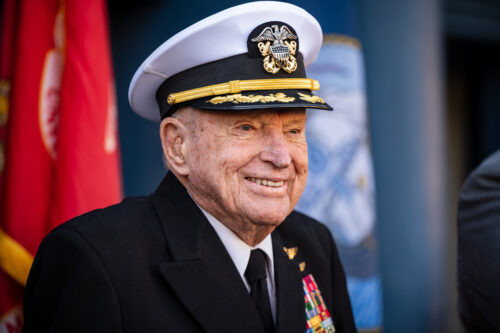
The Valor Has No Expiration Act, proposed by the California Republican who represents the 48th Congressional District, would eliminate time restrictions that currently prevent Captain E. Royce Williams from receiving the nation’s highest military decoration for single-handedly downing four Soviet MiG-15 fighters in 1952.
The bill extends and expands provisions from the 1996 National Defense Authorization Act that waived the five-year limitation for Medal of Honor consideration, but only for actions occurring between 1940 and 1990 and only for classified intelligence activities. Issa’s legislation removes the arbitrary 1990 end date and expands the criteria to include acts that were classified or withheld from public record.
“Valor never expires, and neither should the opportunity for our bravest heroes to be recognized with our highest honor,” Issa said in announcing the legislation. “There is no reason why those who went above and beyond are ineligible for the Medal of Honor due to an arbitrary time standard, when their true account may not be known or was kept classified for decades.”
Current federal law requires service members to be recommended and awarded the Medal of Honor within five years of their actions. Williams’ case was kept classified for more than 50 years, making him ineligible under existing statutes despite what military analysts describe as one of the most remarkable individual combat achievements in U.S. aviation history.
On Nov. 18, 1952, then-Lieutenant Williams was flying an F9F-5 Panther from the aircraft carrier USS Oriskany when he encountered seven Soviet MiG-15 aircraft over Korea. When his flight leader was forced to return to the carrier due to mechanical problems and his wingman pursued a downed enemy aircraft, Williams found himself alone against the remaining Soviet fighters.
The ensuing 35-minute dogfight resulted in Williams shooting down four MiG-15s, an accomplishment no other American fighter pilot has achieved in a single engagement. Williams was flying what he later described as an inferior aircraft, noting that the MiG-15 held significant advantages in speed, maneuverability, acceleration, and firepower.
“They had me cold on maneuverability and acceleration. The MiG was vastly superior on those counts to the F9F,” Williams said in a previous account of the engagement. “The only thing I could do was out-turn them.”
During the fight, Williams fired all 760 rounds of 20mm ammunition aboard his aircraft. His Panther sustained 263 holes from enemy fire, and he lost hydraulic control and rudder function. The aircraft was so severely damaged that it was pushed overboard after Williams managed to land on the carrier at 170 knots, well above the normal landing speed of 105 knots.
An NSA team aboard the cruiser USS Helena recorded radio transmissions that provided evidence of Williams’ kills. Following the engagement, Williams was interviewed by Navy admirals, the Secretary of Defense, and President Harry Truman. He was then ordered to remain silent about the incident due to concerns that publicizing a direct engagement with Soviet pilots could escalate Cold War tensions and potentially trigger a broader conflict.
The classification of Williams’ actions remained in effect for five decades. When the engagement was finally declassified, Russian military records confirmed that Williams had indeed shot down four Soviet aircraft, validating the NSA’s original assessment.
In 1953, Williams received the Silver Star Medal for his actions. He went on to become the top-scoring carrier-based naval aviator of the Korean War and retired as a Captain in 1975 after 32 years of service that included combat missions in World War II, Korea, and Vietnam.
A years-long campaign to secure Williams appropriate recognition gained momentum in 2022 when a bipartisan group of five Congress members successfully amended the Defense Authorization Act. On January 20, 2023, Secretary of the Navy Carlos Del Toro presented Williams, then 97, with the Navy Cross as an upgrade from his Silver Star at a ceremony at the San Diego Air & Space Museum.
“Having reviewed the findings of now numerous investigations related to the case of Captain Williams, I have determined this case to be special and extraordinary,” Del Toro said at the ceremony. “His actions clearly distinguished himself during a high-risk mission and deserve proper recognition.”
However, the Navy Cross, while the service’s second-highest decoration, still falls short of what military historians and lawmakers believe Williams’ actions merit. The Medal of Honor is reserved for service members who distinguish themselves through conspicuous gallantry and intrepidity at the risk of life above and beyond the call of duty.
Issa specifically cited Williams, who is both a constituent and friend, as the inspiration for the legislation. Williams, now 100, resides in Hidden Meadows in the congressman’s district, which encompasses central and eastern parts of San Diego County and portions of Riverside County.
“Captain Royce Williams is an American hero of the highest order,” Issa said. “Every American should know his story, and what he did on that day nearly 73 years ago should go unrecognized no longer. With this reform legislation, America’s heroes, whether undiscovered, unknown, or unrevealed, can be honored as they should. Acts of valor have no expiration date.”
The legislation could have broader implications beyond Williams’ case, potentially benefiting other veterans whose heroic actions were classified for national security reasons and who became ineligible for recognition due to the five-year limitation. The bill addresses what supporters argue is an inherent contradiction in military award systems that fail to account for the realities of classified operations.
Williams’ military decorations include the Navy Cross, two Distinguished Flying Crosses, Legion of Merit with Combat ‘V’, Bronze Star, two Meritorious Service Medals, eleven Air Medals, and numerous other combat and service awards accumulated over his three-decade career.
The pilot’s achievement stands as the longest air-to-air engagement in U.S. military history and represents a unique chapter in Cold War aviation combat, where American and Soviet pilots engaged directly while their governments maintained the fiction that such encounters were not occurring.
If enacted, the Valor Has No Expiration Act would remove the temporal barriers that have prevented full recognition of Williams’ actions and potentially open the door for other veterans whose classified service has gone unrecognized due to statutory limitations rather than the merit of their actions.
For more information, hit the Source below