Sweden has confirmed it can deliver Gripen E fighter jets to Ukraine within the requested timeline and will establish a joint defense innovation hub with Swedish personnel stationed on Ukrainian soil, Swedish Defense Minister Paul Johnson and Ukrainian Defense Minister Dennis Shimal announced at a press conference in Stockholm on Nov. 6.
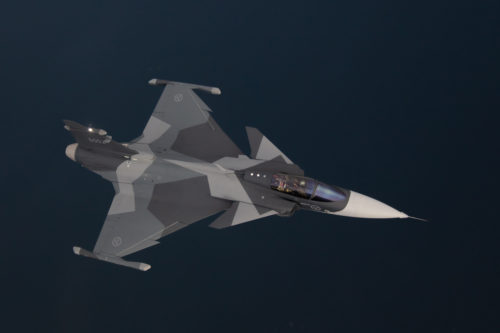
The announcement represents a major expansion of defense cooperation between the two nations, building on a letter of intent signed during Ukrainian President Volodymyr Zelenskyy’s Oct. 22 visit to Sweden. That agreement outlined a potential deal for 100 to 150 Gripen aircraft, which Prime Minister Ulf Kristersson described as an “extremely comprehensive agreement” aimed at building an entirely new Ukrainian air force.
Johnson confirmed that Sweden sees it as possible to deliver the advanced Gripen E model within Ukraine’s requested timeline, though the ministers declined to specify exact dates publicly. The two countries have established a joint working group to finalize details on financing, training schedules, and delivery timelines, with contract negotiations expected to conclude within days or weeks.
“This is the beginning of what we hope and assume is going to be a very close partnership between our two air forces and between our two defense industries and between our two countries,” Johnson said. “It’s not only about aircraft, but it’s also about building a new air force for the future defense of Ukraine.”
Ukraine has expressed interest in receiving aircraft in 2026, though Gripen E production typically requires three years from contract signing. To address this gap, Sweden has not ruled out the possibility of delivering earlier-model Gripen C or D variants as an interim solution while the more advanced Echo models are manufactured.
Shimal said Ukrainian pilots and mechanics are ready to begin training immediately in Sweden, where facilities and simulators have been confirmed ready. “We are ready immediately to send personnel to Sweden,” he said, adding that training will be conducted entirely in Sweden rather than Ukraine due to existing infrastructure and specialist expertise.
The defense ministers also signed a letter of intent establishing a joint innovation hub in Ukraine where Swedish personnel will work alongside Ukrainian counterparts on battlefield technology development. The hub will integrate with Sweden’s Defense Research Agency, Armed Forces procurement organization FMV, and innovation agency Vinnova, as well as a new Defense Innovation Unit being established within the Swedish Armed Forces.
“Swedish personnel will be on site in Ukraine,” Johnson emphasized. “This will strengthen our shared ability to develop and produce new battlefield technologies.” The hub will focus on rapidly moving technologies from concept to battlefield deployment, leveraging Ukraine’s combat experience with Sweden’s advanced defense technology and industrial base.
Innovation areas include drone interceptors for air defense, deep strike drones and missiles, electronic warfare systems, and various IT and engineering innovations. Technologies can be tested directly in Ukraine on testing fields or even on the battlefield itself, a process referred to as “Ukraine approved,” before decisions are made on production location.
Shimal noted that some Ukrainian companies involved in the cooperation cannot be publicly named because Russian forces would target their facilities. However, he confirmed that multiple agreements and letters of intent between Swedish and Ukrainian companies have already been signed, with some Swedish partners prepared to establish production facilities in Sweden.
The Gripen program faces significant financing challenges, but Ukraine has proposed a four-source funding model. Shimal outlined the approach: confiscated Russian assets as Ukraine’s contribution, Swedish military aid allocations, fundraising from European partners, and loans from international financial institutions potentially structured over 30 years.
“We will discuss today the possibility to go to negotiations with international institutions to give a loan to Ukraine to pay for Gripen as a project for the next, for example, 30 years,” Shimal said. “I think that it will be a very significant part of this financing.”
Sweden has committed approximately 17 billion dollars in total support to Ukraine, including 9 billion dollars provided since the full-scale invasion began and an additional 8 billion dollars allocated for 2026 and 2027. The latest defense package included Archer artillery systems, Tridon MK2 air defense systems, Giraffe 1X radars, armored vehicles, and ammunition.
Johnson also highlighted Sweden’s role as co-chair with Germany of the Electronic Warfare Coalition, which includes 12 other countries. Shimal described the coalition as “one of the most important” for defending against Russian aggression, noting that more than 50 percent of Russian drones are currently being neutralized using electronic warfare capabilities. The ministers agreed that electronic warfare represents another important dimension of deepening bilateral and trilateral cooperation between Sweden, Germany, and Ukraine.
Ukraine has also proposed joint defense production projects combining both nations’ capabilities, including co-development of surface-to-air interceptors and co-production of radar systems, with some manufacturing to be localized in Ukraine.
The cooperation extends beyond bilateral ties. Ukraine recently participated in the Joint Expeditionary Force meeting for the first time in its history, a significant milestone that provides a platform for cooperation with more than ten nations including Nordic countries, the United Kingdom, and Baltic states. The JEF was established over a decade ago in response to Russia’s occupation of Crimea.
Regarding the battlefield situation, Shimal reported that front lines have remained relatively stable in recent months due to what he called a “drone wall” creating a kill zone of five to twenty kilometers where equipment and troops cannot move. Russian advances have been limited to periods of poor weather when drone effectiveness is reduced.
The most difficult situation remains in Pokrovsk, where approximately 200 Russian forces have infiltrated streets and basements, though the city center remains under Ukrainian control. In the Kursk region, about 60 Russian forces are in similar positions, with Ukrainian forces conducting cleanup operations. “We continue fight for these small but very important for us cities,” Shimal said.
Sweden’s support, Johnson emphasized, represents both a moral imperative and strategic necessity. “Russia’s illegal war against Ukraine is a serious threat to Europe and European security,” he said. “Supporting Ukraine is both the right thing to do and it’s the smart thing to do. And it’s also an investment into our own security.”
The ministers expressed urgency about moving forward quickly, particularly as Ukraine faces what Shimal described as a “difficult winter” with continued Russian attacks on civilian infrastructure. Ukraine has requested additional missiles for existing air defense systems to counter what he termed Russia’s “air terror against civilians.”
“We ask about this all the partners because we are in the face of the difficult winter and Russia continues their terror,” Shimal said, thanking Sweden for its unwavering support while emphasizing the need for continued assistance across all dimensions.
For more information, hit the Source below