Saab is moving aggressively to expand Gripen production capacity to 36 aircraft per year, a significant increase driven by a swelling order book and growing interest from countries reconsidering their reliance on traditional defense suppliers.
The Swedish manufacturer signed contracts for 21 new Gripen E/F fighters in 2025, with Thailand ordering four aircraft in August and Colombia committing to 17 in November. Michael Franzén, chief marketing officer for the Gripen program, told reporters at Singapore Airshow that the company expects another strong year in 2026.
“We had a fantastic 2025,” Franzén said. “We’re quite happy and proud of what we achieved, especially during last year. We will continue to expand on this this year as well.”
The production increase marks a strategic shift for Saab, which historically focused on technology transfer to partner nations. Now the company is actively seeking to acquire manufacturing capacity in countries with established aerospace industries. The approach reflects both surging demand and the practical challenge of ramping up a complex fighter program when supply chains across the defense sector are already stretched.
Canada’s Mixed Fleet Question
The most intriguing prospect for Saab may be Canada, which is conducting a strategic defense review that includes questions about its fighter fleet composition. Rather than replacing its planned F-35 purchases, Canada is exploring whether adding Gripens to create a mixed fleet would provide better capability and value.
Franzén acknowledged the unusual nature of the campaign. “Many are speculating, you know, will they replace the F-35 with Gripens. I don’t think that is what they’re looking for,” he said. “I think they’re looking for could it be stronger to have a mixed fleet.”
The pitch hinges on complementary strengths. The Gripen offers higher availability, lower operating costs, and rapid adaptability through software updates, while the F-35 brings stealth and other capabilities. For the same budget, Saab argues, Canada could field more total aircraft with a mixed fleet than with F-35s alone.
If Canada proceeds, Saab proposes building initial aircraft in Sweden for quick delivery, then shifting production to Canada using the country’s existing aerospace industrial base. When asked if a Canadian production line would serve only domestic needs, Franzén indicated it would produce for export as well.
The timeline is tight. Canada needs replacement capability before 2032, and speculation suggests the requirement could reach up to 80 Gripens if the mixed fleet concept proceeds. That would require moving quickly through what Saab acknowledges will be a complex process of integrating a second fighter type into Canadian operations.
Established Campaigns Progress
Saab’s active campaigns span three continents. In the Philippines, the company is responding to a requirement for 40 multi-role fighters, though the procurement has dragged on for years as the government works through funding approvals. The Philippines is also considering Saab’s GlobalEye airborne early warning system and command and control offerings, though whether these would be bundled with fighters remains unclear.
Peru has approved budgets for 24 new fighters and Saab believes it’s in the final competition, backed by both Swedish and UK government support. The company frames the opportunity as significant but acknowledges that political factors beyond aircraft capability may influence the decision.
In Ukraine, President Volodymyr Zelensky visited Saab’s facilities in October 2025, and Sweden signed a letter of intent covering 100-150 Gripen aircraft. The agreement is government-to-government, with Saab supporting Swedish authorities. Franzén said the company is also exploring cooperation with Ukrainian defense firms, though the wartime environment creates unique challenges. Separately, discussions continue about providing interim Gripen C/D models more quickly, though Saab itself has no surplus aircraft and any such transfer would come from existing operators.
Longer-term prospects include Austria, which plans to start replacing its early Tranche 1 Typhoons with a formal request for information expected this year, and Portugal, which needs to replace aging F-16s. Ireland has also discussed fighters as it builds defense capabilities, though Saab sees that as a more distant possibility.
Changing Industrial Model
The production expansion requires Saab to fundamentally change how it works with partners. Franzén explained that the company already has contracts with suppliers and is working to increase their output, but beyond a certain point, Saab will need additional sources.
“Today we need industrial cooperation to ramp up,” he said. “We need to strengthen our production. We need to increase production.”
That makes countries like Canada and Portugal, with their established aerospace sectors, particularly attractive as potential production partners. Hungary is already part of this strategy. Saab is establishing an aviation development center in Budapest and hiring software developers there to work on Gripen systems. Hungary is also receiving four Gripen C fighters in early 2026 under a contract signed two years ago, and the air force is celebrating 20 years of Gripen operations.
The first major milestone of the new production approach comes in the first quarter of 2026, when Brazil rolls out the first Gripen assembled at the Embraer facility in Gavião Peixoto. That aircraft will be the first supersonic fighter produced in Latin America. A two-seat Gripen F, assembled in Sweden, will roll out in the second quarter with first flight also planned for that period.
Operational Experience Builds
Brazil continues to lead Gripen E operations, having introduced the type about a year and a half ago. The Brazilian Air Force has certified in-flight refueling with its KC-390 tankers and successfully fired Meteor missiles at drone targets. Brazil’s original contract covers 36 aircraft, with room for expansion given the country’s size and defense needs.
Sweden introduced the Gripen E to operational squadrons in October 2025 at Wing 7 in Såtenäs, though the procurement agency had been working with test aircraft earlier. The Swedish Air Force is running exercises that combine Gripen E and the older C/D models, and initial results suggest the new variant’s enhanced sensors and situational awareness significantly boost overall capability even in mixed formations.
The Swedish program includes continued weapons integration, short runway verification for dispersed road-base operations, and tactical trials that Franzén declined to detail. An MS22 software release coming in 2026 will add enhanced sensors, improved data fusion, and interface refinements. Sweden will also receive an electronic warfare simulator for building threat libraries and training.
Technology as Differentiator
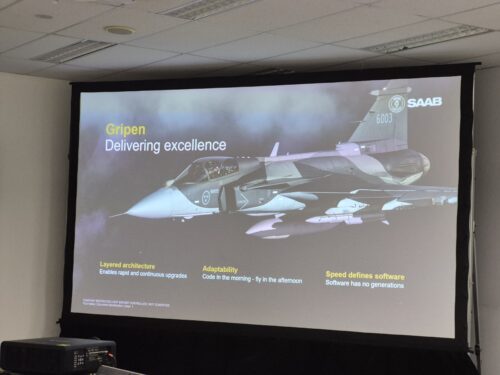
Saab’s primary technical pitch centers on the Gripen’s layered software architecture, which allows rapid updates without lengthy development programs. The company has demonstrated this through Project Beyond, integrating a third-party AI agent into the aircraft in six months from project start to first flight. A second AI agent was trained and flown just two months later.
“Nobody else has done this,” Franzén said. “This is now, we have the adaptability so that we can code in the morning, fly in the afternoon.”
In practice, updates typically take a few days rather than hours, but the contrast with traditional fighter development timelines is stark. The AI work has focused on beyond-visual-range combat scenarios, with agents learning to control aspects of the mission. Saab used production aircraft rather than special test platforms, simply loading the software and flying.
The architecture also positions Gripen to control autonomous platforms that are increasingly central to future air combat concepts. Rather than requiring years of integration work, Saab argues, the necessary software can be added as UAVs and loyal wingman concepts mature.
Market Dynamics Shift
Franzén outlined what he described as three waves of increased fighter demand. Defense spending began rising in some countries even before Russia’s full invasion of Ukraine. That invasion triggered a second wave, particularly in Europe, as nations recognized the need to rebuild military capability. More recently, uncertainty about U.S. foreign policy and alliance commitments has created a third surge of interest.
“The demand and the interest and the urgency in the questions has increased a lot,” Franzén said.
The Swedish prime minister’s assessment that “we’re not at war, but we’re not at peace either” captures the security environment driving procurement decisions. For Saab, this translates into countries that previously planned fighter purchases years in the future now wanting to move immediately.
If Canada tries to back out of the F-35 Deal. Then expect the Americans to be “furious” and Trump to massively retaliate! As Trudeau and Carney have been playing politics over the F-35 for over a decade. In short, they used the program as a political weapon against their opponents. This would be a bridge too far with the Americans.