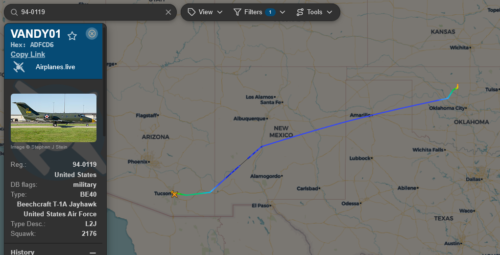
The U.S. Air Force retired the T-1A Jayhawk on Aug. 20, quietly ending more than three decades of service for the twin-engine jet that trained generations of pilots bound for the airlift and tanker fleet. The last operational aircraft departed Vance Air Force Base for Davis-Monthan Air Force Base in Arizona, where it will be received into the 309th Aerospace Maintenance and Regeneration Group, known widely as the boneyard.
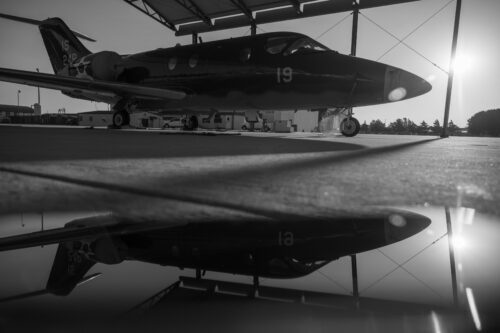
The aircraft making that final flight, tail number 94-0119, carries a heritage paint scheme honoring the 24th Pursuit Group and its 3rd Pursuit Squadron, a unit that was based in the Philippines and came under attack in the opening hours of the Pacific war in December 1941. The jet, assigned to the 3rd Flying Training Squadron at Vance, wears markings that recall that earlier generation of Army Air Forces pilots even as it closes out its own career.
U.S. Air Force units have used similar heritage schemes on other T-1As over the years. Laughlin Air Force Base in Texas painted one of its jets to honor the 86th Flying Training Squadron’s World War Two lineage as a bomber unit, while Columbus Air Force Base in Mississippi has done the same for its own historic squadrons. The paint jobs are meant to connect current student pilots with the units and airmen who came before them.
The T-1A entered Air Force service in January 1992, when the first aircraft was delivered to Reese Air Force Base in Texas. Student pilot training began the following year as the Air Force stood up its Specialized Undergraduate Pilot Training program. The jet became the standard advanced trainer for pilots headed toward the mobility track, giving them their first experience in a multi-engine jet before they moved on to aircraft such as the C-5, C-17, C-130 and KC-135, and later the KC-46.
The T-1A also had a role outside of pilot training. At Naval Air Station Pensacola in Florida, the aircraft was used to train Combat Systems Officers headed for assignments as weapons systems officers and specialists in navigation and electronic warfare. Pensacola retired its last T-1A in July 2025, leaving Vance as the final base flying the aircraft.
The Jayhawk’s roots trace back to Japan, where Mitsubishi built and flew the MU-300 Diamond business jet for the first time on August 29, 1978. Beechcraft bought the production rights to the aircraft in 1986 and redeveloped it as the Beechjet 400. The Air Force selected a militarized version of that jet in 1990 to serve as its Tanker/Transport Training System aircraft, designating it the T-1A. Between 1992 and 1997, 180 of the jets were built for the Air Force, along with a smaller number sold to the Japan Air Self-Defense Force under the designation T-400.
With the T-1A gone, the training pipeline for mobility pilots has changed. Student pilots who complete Undergraduate Pilot Training and are selected for the mobility track now move directly to their Formal Training Units, where they begin instruction on the specific aircraft they will fly operationally, rather than passing through a dedicated advanced jet trainer first.
For a jet that began its life as a Japanese business aircraft and spent more than thirty years preparing American pilots for the airlift and tanker fleet, its last flight came wearing the colors of airmen who flew nearly a century earlier.