The U.S. Air Force and Northrop Grumman have assembled an inert LGM-35A Sentinel intercontinental ballistic missile in its operational, vertical orientation at Vandenberg Space Force Base, California. The stacking concluded a four-month test campaign called Pathfinder and keeps the program on track for its first flight test in 2027, the Air Force and the company said Sept. 14.
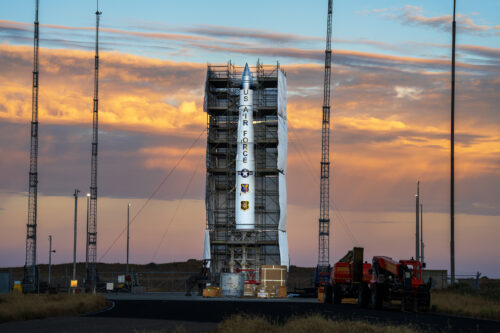
Photo: Northrop Grumman
According to Northrop, the event brought all of the missile’s stages, propulsion elements, shroud and associated components together in a single configuration on a test pad. The company described it as the first fully integrated Sentinel missile. The Air Force said the result shows the missile’s design is maturing and that its critical subsystems remain on schedule for initial flight testing.
Pathfinder was a dry run. Northrop moved missile components on specially designed vehicles from sites across the country to Vandenberg. Engineers there used mobile cranes to stack the missile, checked the interface connections on the pad, and then de-stacked it. The company said the exercise was meant to prove that every process needed to assemble the complete missile safely can be carried out at the launch site.
The Air Force said the campaign also verified parts of the weapon system’s operational lifecycle. That included confirming that handling processes and personnel can carry out complex field assembly.
At the same time, the Air Force Test Center’s 719th Test Squadron completed a first flight test design review. Northrop called it a Critical Design Review, while the Air Force release referred to it as a Design Review. Both said the review confirmed that the missile’s design maturity and hardware testing meet requirements ahead of flight testing in 2027. The Air Force listed performance, safety and mission assurance as the criteria. Northrop listed performance, safety and schedule.
Gen. Dale White, director of Critical Major Weapon Systems for the Department of War, said the integration reflects a commitment to “moving forward with the pace necessary” to modernize the ground-based leg of the nuclear triad. He said Sentinel is now “a physical, fully integrated system” rather than a set of designs. Maj. Gen. William S. Rogers, the Air Force’s portfolio acquisition executive for intercontinental ballistic missiles, said the campaign showed the logistics pipeline and test operations “work in complete lockstep.”
Amanda Davis, vice president and general manager of strategic deterrent systems at Northrop, said the assembly shows momentum toward a test launch in 2027 and toward having missiles on alert by the early 2030s.
Sentinel is the Air Force’s replacement for the Minuteman III, which has been in service for decades. Northrop leads a team of more than 500 partners under an engineering and manufacturing development contract. The company says about 10,000 people work on the program and that the system is designed to remain viable through 2075. Those figures come from Northrop.
The stacking comes after a difficult period for the program. In 2024, Sentinel breached the cost growth thresholds set by the Nunn-McCurdy law, which led the Air Force to restructure the effort, including changes to the plans for silos and launch facilities. Neither of the Sept. 14 announcements addresses cost, and neither says how the 2027 flight test date compares with earlier schedules.
The milestone also has limits. The missile was inert, and the test covered assembly and handling on a pad. It did not involve a launch or a silo. Propulsion performance, stage separation, guidance and reentry have yet to be demonstrated in flight. The releases do not say whether a reentry vehicle or a mass simulator was part of the stack. They also do not say when the stacking took place, only that the campaign lasted four months. The claims of progress come from the Air Force and the contractor, and no independent assessment accompanied them.
The next major event is the 2027 flight test, followed by initial capability in the early 2030s. White said the Air Force will “keep driving” toward a modernized strategic deterrent, and the service said Sentinel remains on track to field initial capability in that period.
For more information, hit the Source below