Airbus Defense and Space is positioning Europe as a reliable alternative to traditional U.S. defense partnerships in Asia-Pacific, citing growing regional interest in supply chain diversification and concerns about policy predictability from Washington.
Speaking at a media briefing on the sidelines of the Singapore Airshow, Zakir Hamid, Airbus’s manager for Asia-Pacific, said the company has seen an uptick in interest from countries looking to broaden their defense procurement options. The shift, he suggested, has been building since COVID-19 supply chain disruptions and the Ukraine conflict, but recent uncertainty around U.S. policy has accelerated the trend.
“There is an uptick, and I think it’s not only driven by that specific reason you mentioned, but countries are looking at diversifying the choices they make to ensure they can have sustainable dependability and reliability,” Hamid said when asked about tensions between the U.S. and traditional partners in Europe and Asia.
The briefing came as Airbus announced two significant developments tied to regional partnerships. Thailand has become the first customer for the A330 MRTT+, an upgraded tanker variant expected to deliver in 2029. Separately, the company certified its A3R fully automated aerial refueling system following five years of collaboration with Singapore’s air force and its defense technology agency DSTA.
The MRTT+ represents what Maria Angeles Marti, Airbus’s head of tanker and derivatives programs, called “the natural evolution” of the company’s tanker platform. Built on the newer A330-800 airframe with Rolls-Royce Trent 7000 engines, the aircraft promises 8 percent better fuel efficiency than the current MRTT. Maximum takeoff weight increases from 233 to 240 tons, and the fuel capacity grows to 111 tons stored in the wings, leaving the main cargo deck free for other missions.
“This aircraft will have better capability in terms of the latest sensors and more capacity to grow,” Marti said. “In this world of defense, we can get farther, or as we are considering, we can refuel more fighters and more aircraft in the life of this platform.”
Airbus currently operates 17 MRTTs across three Asia-Pacific nations: Australia, South Korea, and Singapore. The company claims to be winning more than 90 percent of tanker competitions outside the United States, with 85 firm orders from 18 nations globally and over 350,000 flight hours accumulated since 2014.
The A3R automated refueling certification announced this week marks another milestone in the Singapore partnership. The system provides full automation of boom refueling operations in a 24-hour envelope, day and night, and has been cleared for use with MRTT, F-16, and F-15 fighter aircraft. Marti said Canada has already committed to the upgrade, with other customers in discussions.
The automation roadmap extends beyond the current certification. Airbus is developing what it calls “remote” refueling capability, where operators could control aircraft from kilometers away, and eventually fully autonomous aerial refueling operations. “We expect to have this capability more in 10 years time scale, but we are building already the technological bricks to get there,” Marti said, noting this would be crucial for refueling drones and unmanned fighters.
On maritime patrol, Airbus confirmed it’s developing a long-range solution based on the A321 XLR platform, currently under contract with the French Navy. Marti said the program has generated interest in the Asia-Pacific region, though she declined to name specific countries. When asked how the platform would compare to Boeing’s P-8 Poseidon, she positioned it as a next-generation alternative. “We want to bring the best long-range capability, and we believe the best platform we have today is the A321 XLR. This is a brand new aircraft,” she said.
The company’s smaller C295 tactical transport continues to expand its Asia-Pacific presence, with 38 units now serving six countries: India, Indonesia, Thailand, Vietnam, and the Philippine. Airbus is pushing the maritime patrol variant, having recently signed a contract with Spain for what it describes as a state-of-the-art configuration.
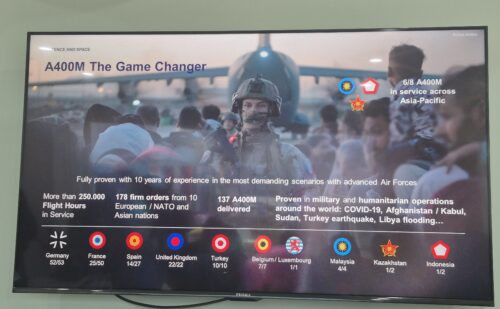
For the A400M strategic airlifter, the focus remains on proving the platform’s value to existing customers while highlighting new capabilities. Gerd Weber, representing the A400M program, noted that Malaysia’s four aircraft lead the fleet in flight hours, demonstrating intensive operational use. Indonesia took delivery of its first aircraft last year and immediately deployed it for flood relief operations.
Weber outlined three major enhancements in development: a payload increase to 40 tons from the current 37 tons, a modular firefighting kit with 20-ton water capacity that can be installed in two hours, and a “mothership” concept that would allow the A400M to deploy medium and heavy UAVs for surveillance and potentially strike missions.
The briefing also emphasized Airbus’s regional technology footprint, with three of the company’s four global tech hubs located in Japan, Korea, and Singapore. These facilities focus on future energy technologies, advanced lightweight composites, and next-generation defense and space technologies.
Hamid said the company is developing multi-domain operations capabilities through what it calls the “multi-domain combat cloud,” a system designed to integrate air, land, sea, space, and cyber domains using cloud-based technology aligned with NATO standards. The goal is to ensure the right information reaches the right asset at the right time.
All Airbus defense platforms have been certified to operate on 50 percent sustainable aviation fuel, with the Royal Air Force having tested the MRTT at 100 percent SAF. The company framed this as supporting national environmental commitments alongside military capability requirements.
When asked about potential Singapore interest in the A400M, Hamid acknowledged the country’s expanding training footprint, including plans to triple troop size in Australia by 2028. He suggested the A400M would fit Singapore’s needs for an “optimal mixed fleet” that could support organic airlift while also refueling helicopters during deployments. However, he noted that procurement timelines are complex and any decision would be made when Singapore is ready.
The company acknowledged ongoing work to reduce A400M operating costs, now more than 10 years into service. Weber said Airbus is identifying areas where the aircraft was being over-inspected and progressively reducing maintenance requirements to what’s actually needed.
On the MRTT automated refueling upgrade path for existing customers, Marti confirmed that retrofitting current aircraft requires physical modifications beyond software updates. She also said the company can still perform conversions of secondhand A330-200 aircraft to MRTT standard, but the window is narrowing as suitable aircraft age out of the conversion pool.