A Japanese naval fighter that had rested on the seafloor for more than eight decades was pulled from the waters off Kagoshima Prefecture on Apr. 8.
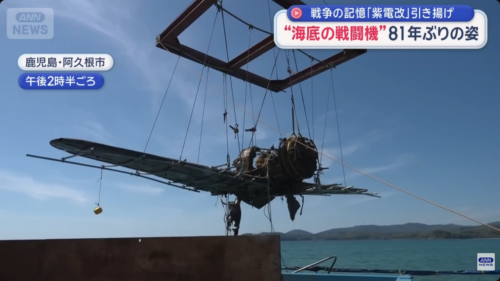
The aircraft, a Kawanishi N1K Shiden-Kai (紫電改), emerged from roughly four meters of water at approximately 2:30 PM local time, lifted by a crane barge to the applause of onlookers gathered along the shoreline. The recovery was reported by both TV Asahi’s ANN network and the Minami-Nippon Shimbun.
By the time the Shiden-Kai entered frontline service, Japan was fighting a defensive war. ANN reported that the aircraft was regarded by the Imperial Japanese Navy as a critical interceptor for homeland defense, arriving, as one salvage organizer described it, “like a comet” in the final desperate phase of the conflict. It was fast, well-armed, and represented one of the more capable Japanese fighter designs of the era. But it came too late, and too few were produced to change the course of the war.
The particular aircraft recovered on Wednesday has a known history. According to the Minami-Nippon Shimbun, it was flown on Apr. 21, 1945, by Captain Hayashi Yoshishige, a Kanagawa native operating out of the Imperial Navy’s First Kokubun Air Base in present-day Kirishima City. After engaging enemy aircraft over Izumi, Captain Hayashi made an emergency water landing off the coast of Akune. He survived the war but was later posthumously promoted to the rank of Major. The aircraft did not make it back. It settled into the sand approximately 200 meters from shore, where it remained for 81 years.
The effort to bring the Shiden-Kai back to the surface was not spontaneous. The Minami-Nippon Shimbun reported that a Kagoshima-based NPO, the Society to Pass on the War Heritage of Hokusatsu to Future Generations, began conducting site surveys and fundraising as far back as 2024. The group is led by Hidemoto Eisuke, 71, who is based in Izumi City.
Preparations in the weeks before the Apr. 8 operation involved a local construction company and volunteer divers, including Oka Shinichi, 58, from Osaka Prefecture. The team excavated sand from around the airframe and threaded steel pipes beneath the main wings to create a stable lifting platform, according to the Minami-Nippon Shimbun.
The salvage itself proved more difficult than anticipated. Work began around 10 AM as the tide reached its peak, but the aircraft was heavier than the team had calculated, forcing a temporary halt. Operations resumed at 2:30 PM, and the aircraft’s wings, spanning approximately 12 meters, finally broke the surface. Both wings were reported to still carry their twin-mounted machine guns. The engine section was also recovered.
Given the conditions, the aircraft’s state of preservation drew genuine surprise from those present. ANN noted that the nose section, where the propeller assembly would have been mounted, and both wings remained identifiable. Hidemoto, speaking after the operation, said the aircraft looked beautiful despite its damage, expressing relief that so much of the original structure had survived.
A woman named Ejima Kaori, 47, who traveled from Yatsushiro City in Kumamoto Prefecture, told the Minami-Nippon Shimbun that her late grandfather had served under Captain Hayashi. She said the aircraft was more intact than she had expected, and that she wanted to show photographs of it to her children. A local outdoor guide, Tsuzaki Shino, 49, told the same publication that he had brought kayakers out to view the submerged aircraft on previous occasions, describing a feeling of being watched over by it. An 82-year-old local resident, who said he had grown up hearing stories about the Shiden-Kai, told the Minami-Nippon Shimbun he felt a quiet sadness at its removal from the sea.
The recovered sections were transported to Kome-no-tsu Port in Izumi City following the operation. According to the Minami-Nippon Shimbun, the aircraft will undergo a desalination process expected to take more than a year before any restoration or display work begins. The NPO’s stated goal is to exhibit the aircraft publicly as a war heritage artifact.
For Hidemoto and his organization, the motivation behind the project goes beyond aviation history. ANN reported him saying that a growing number of people are unaware that the war even happened, and that the goal was to give people something real to look at. “We want people to see it in physical form,” he was quoted as saying.
Intact or substantially preserved Japanese naval aircraft from the Second World War are exceptionally rare. Most were destroyed in combat, scrapped after the surrender, or lost to decades of deterioration. The Shiden-Kai recovered off Akune now stands as a candidate for one of the few surviving examples, pending the restoration work ahead.
For more information, hit the Source below