Australia’s air intelligence, surveillance and reconnaissance (ISR) capabilities took a significant step forward this week after three Royal Australian Air Force (RAAF) platforms reached major milestones within the space of six months, the Department of Defence announced on Sept. 22.
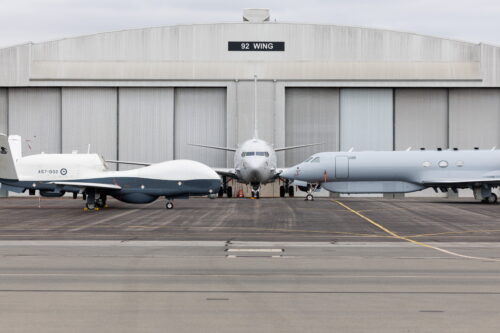
This image has been digitally altered. *** Local Caption *** On Tuesday 22 September 2026, Acting Prime Minister and Minister for Defence, the Honourable Richard Marles MP, accompanied by Chief of Air Force Air Marshal Stephen Chappell DSC, CSC, OAM, visited RAAF Base Edinburgh to announce a series of significant milestones for Australia’s Air Intelligence, Surveillance and Reconnaissance (Air ISR) capabilities. The Acting Prime Minister announced the achievement of Initial Operational Capability (IOC) for the MQ-4C Triton and MC-55A Peregrine, the completion of major upgrades to the first two P-8A Poseidon aircraft in Australia’s fleet in the United States, and the forthcoming commencement of upgrades to the remaining fleet at the recently opened Deep Maintenance and Modification Facility at RAAF Base Edinburgh. These milestones represent a significant enhancement to the Royal Australian Air Force’s ability to deliver persistent intelligence, surveillance and reconnaissance effects across Australia’s primary area of military interest. RAAF Base Edinburgh is the Royal Australian Air Force’s principal Air ISR hub and home to No. 92 Wing, which operates the P-8A Poseidon, MQ-4C Triton and MC-55A Peregrine through Nos. 9, 10, 11, 12 and 292 Squadrons. Built through years of collaboration between Defence, industry and the United States, Australias integrated Air ISR fleet continues to grow.
The MQ-4C Triton uncrewed aircraft and the MC-55A Peregrine electronic warfare and intelligence aircraft have both achieved Initial Operational Capability (IOC), while the P-8A Poseidon maritime patrol fleet has reached full strength with the arrival of its 14th and final airframe. Defence officials say the combined progress marks a substantial expansion of the Australian Defence Force’s (ADF) ability to monitor activity across the region and respond to developing threats.
Deputy Prime Minister and Defence Minister Richard Marles said the milestones reflect the government’s ongoing commitment to the country’s ISR posture and pointed to South Australia’s expanding role in that effort. He said the government is investing roughly $5.5 billion over the coming decade to build out the ADF’s air intelligence, surveillance, reconnaissance and maritime patrol capabilities.
The Triton, a long-endurance unmanned aircraft built by Northrop Grumman, reached IOC following an extended period of operational testing and evaluation. The aircraft flies out of RAAF Base Tindal in the Northern Territory and is operated by Air Force’s No. 9 Squadron, which is based at RAAF Edinburgh in South Australia. Defence officials describe the Triton as a central piece of the country’s long-range surveillance capability, providing persistent coverage that crewed aircraft cannot sustain over the same distances or duration.
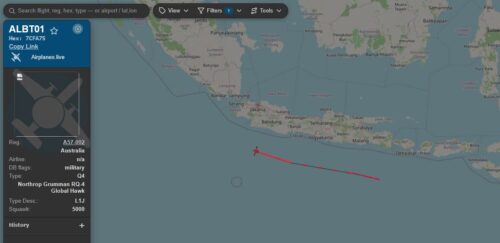
In the weeks before Tuesday’s announcement, flight tracking data showed a Triton flying off the coast of Indonesia, tracing a route past Bali and up toward Sumatra before returning to Australia. The flights were not publicly disclosed by Australia’s Defense at the time and offers an early indication of how the aircraft is being used to extend surveillance coverage into Southeast Asian waters ahead of its formal IOC declaration.
The Poseidon fleet reached full strength in May with the arrival of its last aircraft, giving the ADF 14 of the Boeing-built maritime patrol jets in total. The fleet is based at RAAF Edinburgh and flown by Numbers 11, 12 and 292 Squadrons, supporting anti-submarine warfare, anti-surface warfare and broader maritime patrol duties. Alongside the fleet’s completion, the first of two Poseidon aircraft fitted with Increment 3 Block 2 upgrades has arrived in the country, adding capability while preserving interoperability with the United States Navy.
The remaining 12 Poseidons will undergo the same upgrade domestically, with the work carried out by Boeing Defence Australia and local contractors at a newly opened Deep Maintenance and Modification Facility at RAAF Edinburgh. The $200 million facility is intended to build sovereign capacity to sustain and upgrade the Poseidon fleet within Australia rather than relying on overseas depots, while also creating work for the local defence industry.
The third platform, the MC-55A Peregrine, has also reached Initial Operational Capability after its own testing and evaluation period. Three of the planned four aircraft have been delivered so far, with the last due later this year. The Peregrine is based at RAAF Edinburgh and operated by No. 10 Squadron, and is intended to give RAAF a more integrated set of intelligence, surveillance, reconnaissance and electronic warfare tools in support of broader defence operations.
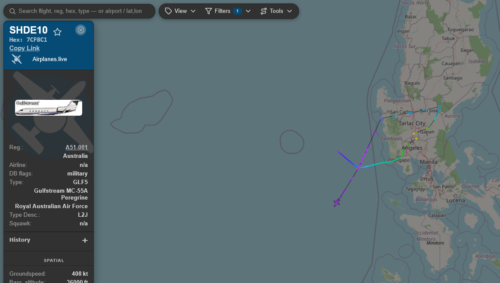
Flight tracking data reviewed ahead of the announcement also showed a Peregrine operating over the South China Sea while based out of the Philippines, a deployment that had likewise gone unannounced by Defence. The sortie points to an operational tempo for the aircraft that extends well beyond Australian waters and suggests the platform is already being used in areas of heightened strategic interest even before its capability was formally declared.
Taken together, the three programs place RAAF Edinburgh at the center of the country’s growing ISR enterprise. Chief of Air Force Air Marshal Stephen Chappell credited the personnel behind the programs, saying they had shown considerable skill in bringing the systems into service and thanking the wider Air Domain workforce across industry, the public service and Air Force for the effort involved in delivering the capabilities.
For more information, hit the Source below