Timothy Wright and Douglas Barrie from the Institute for Strategic Studies (IISS) analyze the recent agreement between the United States and Germany to deploy American long-range conventional missiles to Europe. This decision, announced in July 2024, marks a significant shift in NATO’s approach to long-range strike capabilities.
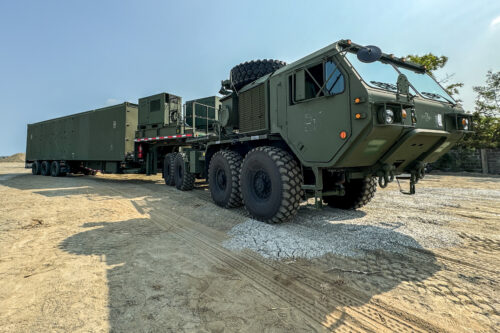
Photo By: Capt. Ryan DeBooy
The authors note that Russian President Vladimir Putin quickly drew parallels to NATO’s 1979 decision to deploy nuclear-armed missiles in Europe. However, they emphasize that this comparison is inaccurate, as the new missiles will carry conventional, not nuclear, warheads.
Wright and Barrie explain that the deployment follows Russia’s development of long-range ground-launched cruise missiles in violation of arms control agreements, as well as its 2022 invasion of Ukraine. The U.S. 2nd Multi-Domain Task Force, activated in Wiesbaden, Germany in 2021, will house these new capabilities.
The analysts detail the types of missiles to be deployed, including the SM-6, Tomahawk cruise missiles, Precision Strike Missiles, and a hypersonic glide vehicle. They highlight that these systems will have ranges between 1,000 and 3,000+ kilometers, potentially reaching targets deep inside Russian territory.
The article also discusses the broader European response. France, Germany, Italy, and Poland have initiated the European Long-range Strike Approach (ELSA) program to develop their own long-range precision-strike systems. This move indicates a growing consensus among NATO allies on the need for such capabilities.
Wright and Barrie contextualize these developments within the broader deterioration of U.S.-Russia relations, particularly the collapse of the Intermediate-Range Nuclear Forces (INF) Treaty in 2019. They argue that while Moscow characterizes these deployments as provocative, they are in fact a response to Russia’s actions, including its war in Ukraine.
The authors conclude that this shift in NATO’s position on long-range ground-launched systems is a direct result of Russia’s aggressive behavior, rather than an unprovoked escalation. They suggest that these new capabilities may serve as a deterrent against further Russian aggression, potentially benefiting regional stability in the long term.
For more information, hit the Source below