Philippines’ Department of National Defense Secretary Gilberto Teodoro Jr. announced on Jun. 30 that the country’s PHP61 billion multi-role fighter program should proceed as a comprehensive “full package” that includes airborne warning and control systems and aerial tankers for mid-air refueling, expanding the scope significantly beyond the original fighter aircraft acquisition.
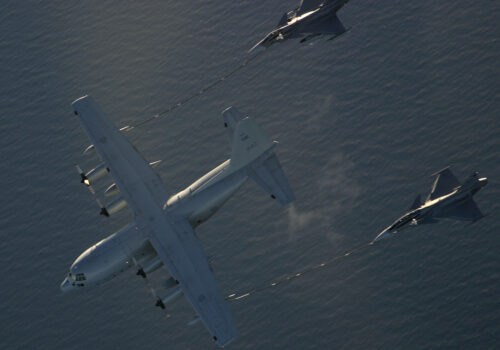
Photo: Saab
The defense chief’s requirements, combined with the Philippine Air Force’s operational needs, appear to favor the Saab JAS-39C/D “Gripen” over the competing Lockheed Martin F-16 Block 70/72 in the ongoing selection process.
The defense chief said the additional platforms are necessary to ensure the MRF program will be “operational as a force package” rather than standalone aircraft that would merely be “flying air shows” or “displayed at the gates of an air base.”
“It is not only the purchase of the MRF per se which we need to deal with but also to make the MRFs operational as a force package, meaning to say we need the AWACS capability,” Teodoro said during a media briefing at the Makati Shangri-La Hotel. “A lot of countries have experienced the fact that they are realizing that they need AWACS, notwithstanding the fact that their satellite capability is not enough.”
In a Jul. 1 social media post, Teodoro revealed that the PAF had already inspected a Saab 340 AWACS in Sweden in 2023, though it was not included in the deal at that time. The defense chief emphasized the need for “mobile radar” to provide real-time information and coordinate air operations, suggesting familiarity with Saab’s airborne early warning capabilities.
The Philippine Air Force confirmed three days later that it had submitted a proposal for acquiring an airborne early warning and control system as part of its Re-Horizon H3 capability development program. PAF spokesperson Col. Ma. Consuelo Castillo said the AEWACS would provide “airborne surveillance, command, control, and communications capabilities, enabling a comprehensive air battle management system.”
PAF Commander Lt. Gen. Arthur Cordura has specified that the multi-role fighters must have the capability to land and operate on short runways. This requirement aligns with Manila’s adoption of the Comprehensive Archipelagic Defense Concept, which aims to protect the country’s territories, including its 200 nautical mile exclusive economic zone.
“The specifications, I need not go to the details but in terms of our selection for MRF, the CADC, our defense campaign plan, our concept for defense entails projection so we need to be able to exhibit credible defense in our EEZ,” Cordura said at Villamor Airbase on Jun. 25. The MRFs must have “a longer endurance, a greater payload, it must have the capability that can land on shorter runways” as future PAF operating bases would be located in the periphery of the archipelago.
The expanded package would complement the Philippines’ existing air assets, including 12 FA-50PH jets delivered in 2017 and 12 additional units ordered in June 2025 under a $700 million deal with Korea Aerospace Industries. The second batch of FA-50PH jets are equipped with aerial refueling capability, meaning the proposed tanker aircraft could service both the FA-50PH fleet and future MRF aircraft.
The MRF program currently has two finalists: the Lockheed Martin F-16 Block 70/72 and the Saab JAS-39C/D “Gripen.” The F-16 Block 70/72 represents the latest and most advanced version of the combat-proven fighter, equipped with advanced radar systems and air-to-air and air-to-ground weapons. The Gripen is classified as a reliable “swing-role combat aircraft” that can operate from small unprepared roads with minimal ground support equipment.
The Gripen’s dispersed operations capabilities address the Philippines’ strategic requirements more directly than the F-16’s conventional airbase approach. The Swedish fighter can operate from roads as narrow as 16 meters wide and as short as 800 meters in length. The aircraft was designed from inception with dispersed operations as a foundational principle, developed during the Cold War when Sweden created the Bas 90 system for dispersed fighter operations.
Thailand, the sole operator of the Saab Gripen in Southeast Asia with 11 aircraft, demonstrated these capabilities in February when the Royal Thai Air Force conducted its first road-based operations using a Gripen fighter. The aircraft successfully landed on Road 4287 in Hat Yai district, Songkhla province, during a simulated attack on its air base, marking the first time a road has been used as a base for combat aircraft in Thailand. The pilots refueled and equipped the aircraft with missiles before taking off during the one-hour exercise.
According to Saab, the Gripen can land, be inspected, refueled, re-armed and turned around in less than 15 minutes using minimal Ground Support Equipment and a small team of one technician and five trained conscripts. The aircraft can use its own power to move to maintenance positions and can even make U-turns on roads if needed. These capabilities would be essential for operating from improvised bases throughout the Philippines’ island geography.
However, both Saab and Lockheed Martin face significant challenges in providing complete packages. Saab could offer its Gripen fighters alongside the proven Erieye Airborne Early Warning and Control System, but the company has no surplus Saab 340 AEW aircraft available for immediate delivery. All six units produced for the Swedish Air Force have been distributed to other countries, with two transferred to Poland, two to Ukraine, and two to Thailand.
Saab would need to modify existing Saab 2000 or Saab 340 airliners into AEW configuration, or offer the more expensive GlobalEye system based on the Bombardier Global 6000 aircraft. The company does not manufacture aerial refueling tankers, though Sweden’s single modified C-130H aerial refueling aircraft could potentially be transferred to the Philippines as Sweden transitions to new Embraer KC-390 transport tanker.
Lockheed Martin faces different constraints. The F-16 uses a boom refueling system, but Lockheed Martin lacks aerial refueling tankers with boom capability in its product line. The company developed a Conformal Air Refueling Tank System for India’s fighter competition that would allow F-16s to use probe-and-drogue refueling, but the system did not proceed to production after India selected the Rafale fighter instead.
For AEW capability, Lockheed Martin and Northrop Grumman developed the Vigilance pod-mounted radar surveillance system over a decade ago that can be mounted on C-130 aircraft. However, the system never matured into a full development program and uses fighter-sized radar that is less capable than Saab’s Erieye system.
The Philippines is acquiring three C-130J-30 Super Hercules aircraft scheduled for delivery in 2026 and has operated legacy C-130s since the early 1970s, providing platform familiarity that could favor C-130-based solutions for both tanker and AEW roles. However, both the Conformal Air Refueling Tank System and Vigilance are development products that have not reached operational status with any military force. Should the Philippines select these systems, it would become the sole operator of both technologies, carrying the risks and costs associated with being the first adopter of unproven systems.
Teodoro acknowledged that the expanded package would “add considerably to the cost” and requires coordination with the Department of Finance and Department of Budget Management regarding funding continuity. He emphasized that the Philippines would not purchase equipment that “will not make a difference and will not add to deterrence.”
“We will not buy standalone equipment. If there are standalones, fine. However, if equipment per se needs support equipment, we will also have to put aside funds for that,” Teodoro said. He cited the need for consensus from the DOF and legislature on annual sustainment spending to ensure the platforms are not merely static displays.
The defense chief said the DND would ensure adequate reserves of munitions per aircraft and stressed his responsibility to make sure “each peso spent can be supported and justified.” He noted that while it is easy to buy MRFs, there is a need to acquire military assets with adequate stores, reserves, and munitions for optimal use.
The announcement represents a significant shift from individual platform acquisition to integrated capability development, reflecting lessons learned from other countries’ experiences with air defense systems. The aerial tankers would create operational synergies across the PAF’s mixed fleet of FA-50PH and future MRF aircraft, potentially making the investment more cost-effective despite the higher upfront costs.
The expansion of the MRF project scope highlights the complex procurement challenges facing both potential vendors, as neither can easily provide complete “full package” solutions with their existing products. The decision will likely require creative combinations of existing platforms and systems, potentially including Gripens from Saab, Erieye AEW systems, and KC-130J aircraft from Lockheed Martin to meet the Philippines’ comprehensive air defense requirements.
For more information, hit the Source below