South Korea’s elite Black Eagles aerobatic team will not participate in the Dubai airshow scheduled for mid-to-late November after Japan refused to provide refueling support at a Japan Air Self-Defense Force base, multiple government sources confirmed this week. The cancellation marks a significant setback for bilateral defense cooperation and highlights the persistent challenge territorial disputes pose to practical military collaboration between the two nations.
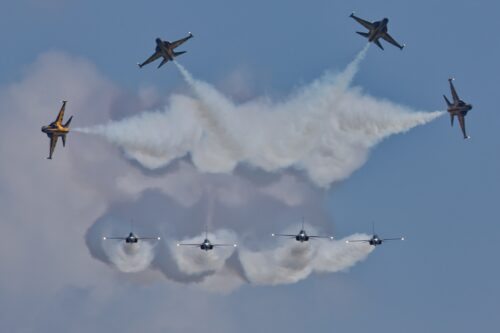
The Republic of Korea Air Force’s special aerobatic team had requested permission to refuel at the Japan Air Self-Defense Force’s Naha Base in Okinawa Prefecture while en route to the United Arab Emirates airshow. Japan initially considered the request positively as part of broader efforts to strengthen defense ties. However, Japanese authorities withdrew their support after discovering that a T-50B aircraft from the team had conducted routine training near Dokdo on Oct. 28, according to diplomatic sources.
Japanese Defense Minister Koizumi Shinjiro announced the cancellation at a Nov. 4 press conference, stating that “coordination between the defense authorities of Japan and South Korea could not be arranged.” South Korean Defense Minister Ahn Kyu-baek, when questioned by lawmakers, acknowledged awareness of the situation but declined to provide details. The South Korean Ministry of National Defense offered no official comment.
The refueling arrangement would have represented the first instance of Japan providing direct logistical support to South Korean military aircraft at a Self-Defense Force installation. Japan and South Korea do not have an Acquisition and Cross-Servicing Agreement, the standard framework that facilitates fuel and ammunition exchanges between allied nations. Japanese officials had planned to invoke Article 116, Paragraph 1 of the Self-Defense Forces Law, which permits free fuel lending when such support does not interfere with the force’s primary missions.
The Black Eagles team has participated in international airshows over the years, typically refueling at Taiwan’s Kaohsiung airport during long-distance flights. Japanese officials viewed the Naha stopover as a more efficient alternative that would reduce both travel time and operational costs. More significantly, they saw the arrangement as an opportunity to build momentum toward eventually concluding a formal logistics agreement and reducing historical South Korean public sensitivities toward the Self-Defense Forces stemming from Japan’s colonial occupation.
According to the Yomiuri Shimbun, the decision to cancel the refueling support was finalized by the Japanese government just before Prime Minister Takaichi Sanae met with South Korean President Lee Jae-myung on Oct. 30 in Gyeongju, where both leaders were attending the Asia-Pacific Economic Cooperation summit. The two leaders subsequently agreed to pursue future-oriented relations during their first summit.
Despite this public commitment and the prior cancellation decision, Prime Minister Takaichi continued to strongly advocate for reversing the decision and proceeding with the refueling arrangement after the summit. However, her efforts proved unsuccessful. Government sources indicated that strong internal opposition centered on concerns that public opinion would not support the decision given the territorial sensitivity. The voices arguing that “it would be difficult to gain public understanding this time” remained too strong within the government, and the cancellation stood.
South Korea maintains effective control over Dokdo, a small island group in the Sea of Japan that Japan claims as Takeshima. The territorial dispute has repeatedly complicated bilateral relations despite shared security interests, particularly regarding North Korea’s nuclear program and growing military cooperation between Pyongyang and Moscow.
Japanese government officials protested the Oct. 28 training flight. South Korean authorities responded that the exercise was standard preparation for the airshow and part of routine operations. The explanation did not satisfy Japanese concerns about proceeding with the refueling support.
By Nov. 6, the deadline for the Black Eagles to depart for Dubai had passed without resolution. South Korean military officials determined that insufficient time remained to arrange alternative refueling at Taiwan or other locations, as such arrangements require advance diplomatic coordination. The team’s participation became impossible.
The cancellation occurred against a backdrop of otherwise improving defense dialogue. On Nov. 1, Ministers Koizumi and Ahn met for the first time in Malaysia, where they agreed to enhance regular consultations between defense authorities and increase personnel exchanges. The two ministers also confirmed close coordination on North Korea’s nuclear development and the growing alignment between Pyongyang and Moscow.
The South Korean government has emphasized its intent to prevent the incident from escalating into broader diplomatic conflict. However, the episode illustrates the practical limitations that historical grievances and territorial disputes continue to impose on Japan-South Korea defense cooperation, even when political leadership expresses commitment to strengthening bilateral ties.
The cancellation also raises questions about future logistics arrangements for South Korean military units participating in international events. The Black Eagles team’s performance schedule requires reliable refueling options for extended overseas deployments. Japan’s geographic position makes it a natural stopover point for flights from South Korea to the Middle East and beyond, but the political constraints demonstrated by this incident suggest that alternative arrangements through Taiwan or other partners may remain necessary for the foreseeable future.
For more information, hit the Source below