A Republic of Singapore Air Force (RSAF) CH-47SD Chinook helicopter touched down at the National University of Singapore (NUS) Multi-Purpose Field opposite University Hall this morning, as part of an exercise to validate ground safety measures and procedures for time-critical medical evacuations to nearby National University Hospital (NUH).
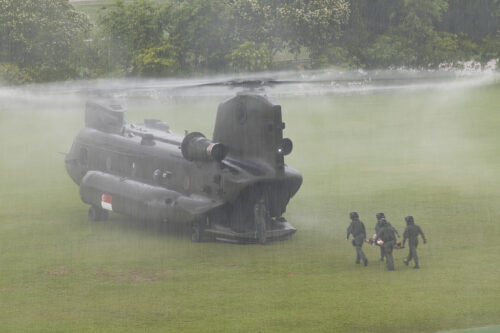
The exercise began shortly after 10am under dark, overcast skies, drawing a crowd of staff and students who had gathered around the field to watch. Once the Chinook landed, four aircrew emerged from the rear of the aircraft carrying a stretcher with a dummy, simulating a casualty evacuation scenario. Shortly after, heavy rain swept across the field. Undeterred, the crew made their way back to the helicopter through the downpour with the stretcher before the CH-47SD lifted off into the rain.
The NUS Campus Emergency and Security (CES) team was on the ground managing the field and surrounding walkways during the exercise, working alongside RSAF personnel to keep onlookers at a safe distance.
Tuesday’s exercise was also not the first time a CH-47 Chinook has set down at the NUS Multi-Purpose Field. A similar exercise was conducted at the same location some 20 years ago, reflecting the site’s long-standing role as a contingency landing zone in the heart of the university campus.
For those watching from the sidelines, the sight of the Chinook lifting off through the heavy rain offered a glimpse of what the RSAF’s medevac capability looks like in practice. The aircraft is able to operate under all weather conditions, whether in driving rain or in the dead of night, a capability that has already been put to the test in a real-world rescue.
In December 2008, the RSAF activated its Long-Range Search and Rescue capability using the Chinook for the first time when a Royal Navy sailor aboard HMS Echo fell critically ill in the South China Sea, beyond the range of Singapore’s conventional rescue helicopter, the Super Puma.
Rather than wait the five or more hours it would have taken the vessel to sail closer to Singapore, then LTC Vincent Chin from the RSAF Air Operations Centre activated the CH-47 Chinook for a casualty evacuation. The mission was led by then LTC Low Chung Guan, Commanding Officer of 127 Squadron, who took off within 45 minutes of activation. A Medical Officer was winched down to the ship to assess the sailor, Leading Rate Ryan Cleary, before the team winched him off the vessel and flew him to Singapore for further treatment.
HMS Echo’s captain, Commander Gary Brooks, said afterwards that the consequences could have been severe had the RSAF not responded as swiftly as it did. “If LH Cleary had not received medical attention for just another four to six hours, he might not have survived,” he said. “While we’re out at sea, it is certainly a reassuring thought that should anything happen, such a swift and capable force is ready to help.”
Tuesday’s exercise at NUS, and the rain that came with it, served as a timely reminder that the RSAF’s medevac capability does not stand down when conditions turn. When the call comes, the Stallions respond.