Members of Japan’s Ground Self-Defense Force are preparing to parachute onto a small island in the northern Philippines later this month, a drill that will put Japanese paratroopers on the ground closer to Taiwan than at any point in recent memory.
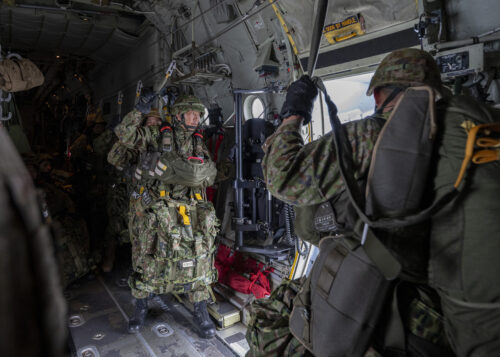
Japanese and Philippine defense officials confirmed this week that personnel from the JGSDF’s 1st Airborne Brigade, based in Narashino, Chiba Prefecture, will conduct a free-fall jump onto Batan Island in Batanes province, the Philippines’ northernmost territory and the closest point of Philippine soil to Taiwan. The drop is part of Kamandag, an annual exercise hosted jointly by the Philippine and U.S. Marine Corps that this year has drawn more than 2,200 participants and will run through Jul. 1.
Speaking at the exercise’s opening ceremony, Philippine Marine Corps Brig. Gen. Bob Apostol said the drill is meant “to evaluate our readiness to address any contingencies that would arise in this region.” He added that the broader goal is to sharpen interoperability and intelligence-sharing among what he called partner forces. Apostol said the Japanese troops will jump from a Philippine military aircraft onto Batan Island, located roughly 200 kilometers from Taiwan. A Philippine Air Force official said the aircraft used could be either a C-130 transport or a Black Hawk helicopter, though it remains unclear which platform will ultimately carry out the drop.
The exercise marks the tenth running of Kamandag and the ninth time Japan has taken part, but this year’s iteration is seen as a meaningful departure from past practice. Japan’s earlier involvement in Kamandag was largely confined to humanitarian assistance and disaster-response training. That changed after a bilateral reciprocal access agreement between Tokyo and Manila took effect last year, opening the door for Japanese forces to participate in more complex, contingency-oriented exercises. The Batanes jump is the most visible result of that shift to date.
Kamandag’s scope this year extends well beyond the Batanes drop. A separate component of the exercise involves an amphibious and airborne operation aimed at seizing an airfield on Thitu Island, a Philippine-controlled feature in the Spratly Islands where Manila and Beijing hold overlapping territorial claims. Taken together, the two drills suggest an exercise built less around routine cooperation and more around rehearsing the kind of operations that would matter most in an actual regional conflict.
Geography is doing much of the work in explaining why the Batanes drill draws attention. The province sits across the Bashi Channel from Taiwan, a waterway that carries a significant share of regional trade but would also serve as one of the more direct corridors for forces moving between the Philippine Sea and the South China Sea in the event of a crisis over Taiwan. Beijing regards Taiwan as a breakaway province to be brought back under mainland control, by force if deemed necessary, which is part of why any military activity in this particular stretch of water tends to carry weight well beyond its size.
The drill itself involves a relatively small contingent of Japanese paratroopers, one piece of a Kamandag exercise that spans multiple islands and thousands of personnel. It comes a year after the reciprocal access agreement between Tokyo and Manila took effect, and follows eight previous years of Japanese participation in Kamandag focused on humanitarian and disaster-response training. Philippine and Japanese officials have not said whether the Batanes jump will become a recurring feature of future Kamandag exercises.
For more information, hit the Source below