A French military safety investigation has concluded that a brief, uncoordinated struggle for control of one of two Rafale fighter jets was central to a mid-air collision in August 2024 that killed two airmen near the town of Colombey-les-Belles in eastern France.
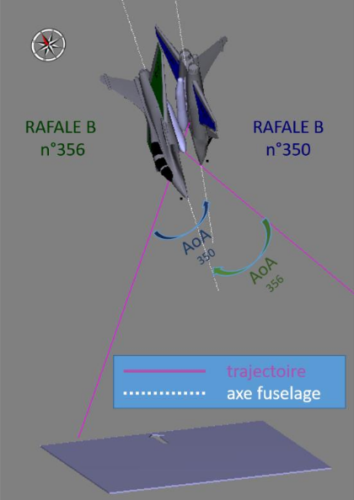
Graphic: BEA-É
The report, published by the Bureau Enquêtes Accidents pour la Sécurité de l’Aéronautique d’État (BEA-É), reconstructs in granular detail the final seconds before two Rafale B aircraft from the Armée de l’Air et de l’Espace’s training squadron, ETR 3/4 “Aquitaine,” struck each other almost belly-to-belly at around 10,000 feet during a training dogfight on Aug. 14 2024.
One pilot ejected and survived with minor injuries. The other aircraft carried an instructor and a student pilot, both of whom died in the collision. Both jets were destroyed and crashed in woodland a few hundred meters apart.
A mission reshaped by weather
The flight began as a routine training sortie out of Saint-Dizier air base, intended to continue a student pilot’s qualification on in-flight refueling. The plan called for the two-jet formation to refuel over Germany, then fly an instrument approach into Luxeuil before returning home at low altitude, with some gun-firing practice along the way.
Poor weather scrapped that plan twice over. After refueling, the crews learned conditions at Luxeuil had deteriorated and rerouted to Nancy instead. Then, descending toward Saint-Dizier, they ran into bad weather at low altitude and turned back, climbing into clearer air over the Nancy training zones. With fuel still available and the skies cooperating there, the flight leader — an experienced instructor — decided to use the remaining time for simulated gun passes, followed by an unplanned air combat exercise known as Basic Fighter Maneuvers, or BFM.
Investigators noted that adjusting a mission’s content in flight like this is common practice and not, in itself, unusual or improper.
Into the merge
The two jets set up in a standard “Butterfly” formation, splitting apart before turning back to pass each other head-on. They crossed, then each pulled into a vertical loop, meeting again upside down near the top. At that point, the wingman — flying alone in his jet — had built a clear tactical edge, coming through faster and higher than the leader, and used it to bank sharply away in a move the report says was effective but largely hidden from the other crew’s view.
The student pilot, at the controls of the lead aircraft, found himself behind in the exercise and rolled hard to bring his jet back toward his opponent to close the gap. That decision, the report found, set both aircraft on course for what investigators term a “zone of uncertain crossing” as they descended out of the loop.
In the final 3.5 seconds of recorded flight data, both jets were flying slowly and at a steep angle of attack, conditions that made them sluggish to maneuver. All three pilots made significant control inputs as the danger became apparent.
A tug-of-war on the stick
It was in this narrow window that the report identifies the chain of events it considers central to the accident. As the student pilot rolled hard right in an attempt to avoid the other jet, the instructor in the back seat tried to correct course with an opposing roll to the left — without pressing the small priority trigger on his control stick that would have overridden the front seat’s input.
On the Rafale, when both pilots move the controls at once without one of them claiming priority, the flight computers simply add the two commands together. With the student commanding full roll right and the instructor commanding full roll left, the result was effectively no roll response at all. For about 1.2 seconds, the lead jet’s trajectory was, in the report’s words, no longer under control.
The instructor then paused his own inputs for roughly nine-tenths of a second, apparently trying to understand why the aircraft wasn’t responding as expected, before finally engaging the priority trigger and rolling hard right in an evasion attempt. By then, only about 250 meters separated the two aircraft. In the other jet, the wingman was caught off guard by the leader’s unexpected rightward turn, which disrupted his own avoidance plan. Neither crew communicated their intentions to the other over the radio during this stretch.
The two aircraft converged head-on and collided, the report concludes, almost belly-to-belly, with the wingman’s engine and wing striking both cockpits of the lead aircraft.
An ejection, and a difficult rescue
The wingman, sensing his aircraft was no longer responsive and losing his cockpit displays, ejected roughly ten seconds after the collision near 6,000 feet. He came down under his parachute, which caught in trees, and managed to reach the ground and call for help on his mobile phone. He later used handheld distress flares to try to attract a search aircraft passing overhead.
In the other jet, neither crew member ejected. Investigators found that the rear ejection seat of the lead aircraft was torn free by the force of the collision itself, and that the impact also caused the harness to release, separating the instructor from his seat and parachute, which were found nearly 12 kilometers from the crash site.
The search for the second aircraft took most of the day. Rescue teams located the first wreckage by mid-afternoon, but conflicting reports about where the second jet might have gone down delayed the discovery of the remaining wreckage and crew member until that night, nearly nine hours after the alert was first raised.
A risk the squadron didn’t fully grasp
Perhaps the most striking part of the investigation concerns how common these clashing control inputs — what the report calls “Dual Input” — turn out to be in everyday training flights. After the accident, investigators quietly asked the squadron to hand over data from fifteen routine training sorties, without telling crews why. Twelve of the fifteen showed instances of Dual Input, some with multiple occurrences in a single flight.
Yet pilots interviewed by investigators believed the phenomenon was rare, or assumed that picking up the stick naturally engages the priority trigger. The report suggests this is a misplaced confidence: the warning light meant to flag the issue, located low in the cockpit, is easy to miss when a pilot’s attention is fixed outside the aircraft during a dogfight, and unlike some civilian airliners, the Rafale gives no audible or vibrating alert when two pilots are fighting the controls.
The report also points to a gap in how instructors are prepared for the role. Most arrive at the training squadron with little prior exposure to flying with another pilot, rather than a navigator, in the back seat, and the transition course that introduces them to the squadron’s Rafale B aircraft touches only briefly on the risks of Dual Input.
Other contributing threads
Investigators also examined the student pilot’s background, noting he had spent two years as an instructor on the PC-21 trainer aircraft before converting to the Rafale. They suggest his instincts for judging closing distances and timing — what pilots call “time to collision” — may have been calibrated to the PC-21’s flight characteristics rather than the Rafale’s, particularly at the low speeds and high angles of attack typical of close-in dogfighting.
The report also flags a broader, longstanding difficulty: pilots are required to maintain a minimum separation of 1,000 feet during these exercises, but have no instrument to measure that distance precisely in the heat of a maneuver, and the Rafale’s own performance routinely brings aircraft closer than that during legitimate, safely-flown engagements. That makes the rule difficult to apply with confidence in real time.
Recommendations
The BEA-É has issued six safety recommendations stemming from the investigation. It is asking the French defense procurement agency, DGA, to study improvements to how the cockpit indicates simultaneous control inputs, and to add a marker in flight data recordings that would let the air force track how often Dual Input actually occurs across the Rafale B fleet. It has also called on the air force to build a more deliberate risk-management approach around the issue, including more attention to it during instructor training, and to look at reinforcing how pilots transitioning from other aircraft build their judgment of closing distances in combat maneuvers. A further recommendation urges continued work on anti-collision procedures tailored to how the Rafale actually flies in close combat, and a final one calls for retrofitting the fleet with a newer flight recorder capable of capturing cockpit audio, which was not available on either jet involved in this accident.
Under French law, the purpose of this kind of safety investigation is strictly to prevent future accidents, and the report explicitly does not assign legal or administrative responsibility for the crash.
For more information, hit the Source below