On the flight line at RAAF Base Darwin, the RAF Voyager sitting among the fighter jets of Exercise Pitch Black looks, at first glance, like the support act. It is not built to dogfight. Its job is to keep other aircraft fueled, to move people and freight across long distances, and, when needed, to carry patients home. But spend twenty minutes walking through its cabin, as a group of journalists did last week, and it becomes clear the aircraft is doing more heavy lifting in this exercise than its size in the formation might suggest.
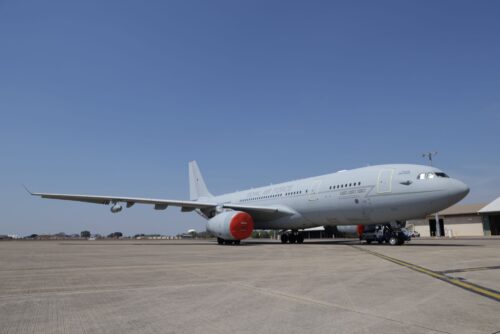
Pitch Black 2026, one of the largest multinational air exercises in the Indo-Pacific, has drawn 21 nations and more than 100 aircraft to bases across the Northern Territory and Queensland. The RAF has sent a single Voyager and around 80 personnel roughly 14,000 kilometres from the U.K. to take part, flying out of Darwin, Tindal and Amberley. Among the trades represented are aircrew, engineers, refuellers, logistics staff, intelligence specialists and, notably, a team from the RAF’s Aeromedical Evacuation Squadron.
That last group is central to what makes this year’s deployment different. The U.K. is the first nation at Pitch Black 2026 to exercise its Strategic Aeromedical Evacuation and Critical Care Air Support Team capabilities — turning a tanker aircraft into a functioning medical transport mid-exercise.
A tanker with a stretcher bay
Walking through the Voyager, the split in its identity is obvious. At the back, the aircraft looks much as any long-haul airliner would. Towards the front, rows of seats give way to a stretcher compartment, part of what the crew call a “role fit” — a configuration that can range from a single stretcher up to, in principle, the entire aircraft rigged for critical care.
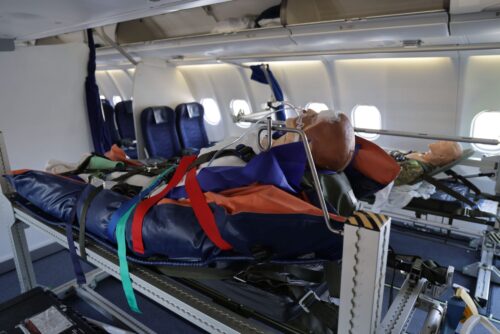
“We have different role fits which go from the basic, which is one stretcher, to what you see now, which is a stretcher compartment with five, and we can have the whole aircraft stretcher C-CAST or critical care support,” said Chief Technician Johnno, a senior engineer with AirTanker who was on hand to walk the media through the aircraft.
Switching between those configurations is not quick. Depending on the scale of the change, reconfiguring the Voyager takes somewhere between 12 and 24 hours. It is not a fit the crew swaps in and out casually and, as it turns out, not one they use often.
A rare capability, exercised carefully
For all the attention the aeromedical role is getting at Pitch Black this year, Johnno was candid about how infrequently it comes into play in real operations. The RAF operates nine Voyager aircraft, and only one carries the aeromedical fit. If that particular aircraft is tasked elsewhere when a medical evacuation request comes in, it simply cannot always be recovered in time.
“I’ve done two in 14 years,” Johnno said, referring to the number of times the aircraft has actually been rerolled for a specific critical care air support requirement during his time on the programme.
That scarcity is part of why the training at Pitch Black matters. During the exercise, crews have been running scenarios built around a patient whose condition worsens in flight — moving from routine care to a critical state — and practising how a general aeromedical team hands that patient over to the specialist Critical Care Air Support Team, or CCAST. It is simulated, but the choreography is real. Earlier in the exercise, the crew carried out what Johnno described as a first for the exercise: transferring a simulated patient from a French aircraft directly onto the Voyager using a Trepel loader, moving the patient on their stretcher without disturbing their position.
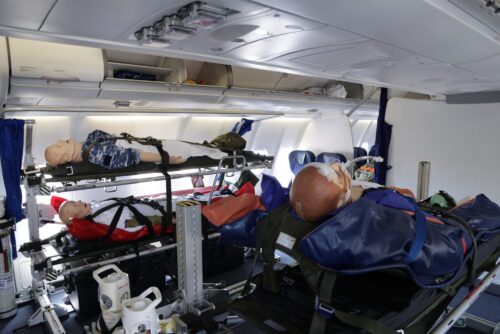
Depending on the mix of aeromedical and critical care staff required, the medical team on board can run to around 18 people; a CCAST-only response would need closer to four or five. Medics from other participating nations have been observing the training, though not working directly alongside the British team.
Johnno also noted that the RAF appears to be the only operator flying aeromedical evacuation missions on the A330 airframe at Pitch Black. Other nations with strategic airlift, such as the C-17 or A400, tend to rely on those aircraft instead, though he suggested the Voyager’s cabin offers a level of comfort that a purely strategic transport aircraft does not.
Asked what determines whether a patient is moved by military aeromedical evacuation rather than through civilian channels, Johnno pointed to a mix of factors such as the nature of the injury, and, often, cost. A civilian route, he said, might also simply lack the reach: a military flight can bring a patient directly into RAF Brize Norton, where onward transport to specialist care in Birmingham is already arranged, whereas a civilian option might involve a longer journey after landing.
A widening role for the tanker
Johnno has deployed to Pitch Black in each of its iterations since 2022, and said the UK’s role in the exercise has grown noticeably over that time. “When we came, we were a bit-part player, and now we’re… when you go to the briefings, we have a large position to play in it,” he said.
He also pointed to a shift in how the tanker itself is used within the exercise. In most air exercises, he said, the tanker tends to be treated as a supporting asset while fighter aircraft take the focus. This year, he said, air-to-air refuelling has been built into the exercise more centrally, giving Voyager crews and engineers a chance to work more closely alongside other nations’ forces.
Johnno’s own position reflects a broader arrangement between the RAF and AirTanker, the civilian company that operates and maintains the Voyager fleet under contract. Day to day, he works in AirTanker uniform as a licensed civilian engineer based at Brize Norton. On deployments and exercises, he switches into RAF uniform as a Sponsored Reservist, coming under RAF command for the duration. It is a role that keeps him away from home for more than 180 days most years, largely in support of Operation Shader and exercises such as Pitch Black.
“Extremely proud,” he said, when asked what it means to represent the RAF at the exercise, adding that the growth he has seen in the U.K.’s contribution over three iterations of Pitch Black has been one of the more satisfying parts of the posting.
For the crews and engineers on the ground in Darwin, the exercise is as much about relationships as equipment. As Johnno put it, the value lies in being able to turn up and help at short notice and knowing partner nations would do the same in return.