A U.S. Air Force C-17 grounded after a severe storm drove two private jets into its fuselage returned to service Jul. 30, thanks to a repair process that Air Force officials say cut what could have been a two-year fix down to about five months.
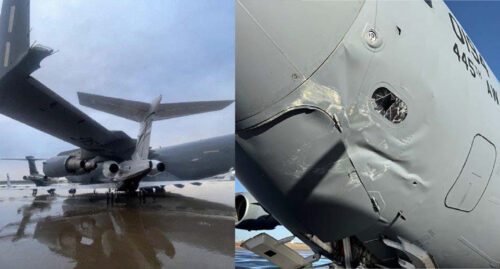
U.S. Air Force courtesy image
The aircraft, assigned to the 445th Airlift Wing at Wright-Patterson Air Force Base, Ohio, was parked overnight at Perot Field Fort Worth Alliance Airport on Mar. 4, 2025, when a line of severe thunderstorms moved through the Dallas-Fort Worth area. Wind microbursts reaching 80 mph tore through the airport, pushing two Bombardier Challenger jets into the C-17’s left side. The collision damaged the aircraft’s door, fuselage and nose area.
The C-17 flew back to Wright-Patterson on a temporary nose panel repair approved by Boeing and the Air Force, its landing gear left down for the trip. Once home, the 445th Maintenance Group repaired the door and fuselage without much trouble. The nose panel was a different story. It needed to be replaced entirely, and Boeing told the Air Force that no vendor was willing to build the tooling required to manufacture a single, isolated part.
That left the maintenance group facing a familiar problem in military aviation sustainment: a part that could not be sourced through normal channels. Early estimates put the aircraft in storage for a year, with the repair itself taking another year on top of that. With only nine mission-essential C-17s in the 445th Airlift Wing’s fleet, losing one for that long was not something the Air Force was willing to accept.
The 445th Maintenance Group turned to the Air Force Rapid Sustainment Office, a division within the Air Force Life Cycle Management Center’s Combat Readiness Directorate, for help. The office’s Advanced Manufacturing Program Office, specifically its Automation and Robotics team, saw the part as a strong candidate for a technology called Incremental Sheet Forming (ISF). The process uses robotics to progressively shape metal sheets into finished, functional parts without the need for the kind of tooling a vendor would normally have to build.
Working with engineers from the University of Dayton Research Institute, the team began producing the panel in January 2026 at the Rapid Sustainment Office’s Integrated Technology Operations Center. The part moved through an initial fit check and testing to confirm it was flightworthy, followed by a final fit check in April. Boeing and the 445th Maintenance Group installed the finished panel in July, and the aircraft completed a front landing gear test along with minor adjustments to the nose area before returning to flight.
“When the mission demanded immediate action, the RSO stepped up,” said Mary Schuler, the Rapid Sustainment Office’s lead program manager for automation and robotics. “By leveraging the ISF, with critical support from UDRI, we didn’t just meet the need. We significantly decreased our timeline, reducing the repair process from years to only a few months.”
Col. Karen Gharst, commander of the 445th Maintenance Group, said the fit-check panel arrived in just over a month after the office got involved, which kept the unit from facing a long work stoppage during a period of heavier operational demand. She credited the partnership with the Rapid Sustainment Office as central to getting the aircraft back on the flight line.
The nose panel is the first part produced through Incremental Sheet Forming to fly on an Air Force aircraft. The Rapid Sustainment Office said it is already applying the same process to parts for a K-135 and an F-15, suggesting the approach could become a more regular option for units dealing with aircraft damage or parts shortages that vendors are unwilling or unable to address through traditional manufacturing.
For more information, hit the Source below