Kawasaki Heavy Industries has shown a concept illustration of a next-generation jet trainer in its Group Vision 2030 progress report, released Oct. 6. The image offers a first look at how the company, which developed the T-4 now in service, may approach replacing it.
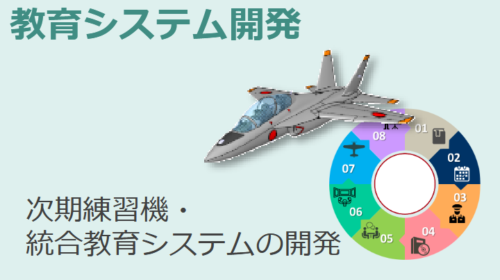
The illustration is small and comes with no specifications, so it is best read as a concept rather than a finished design. Japan’s Air Self-Defense Force has been looking for a T-4 successor for some time, and the program has been slow to take shape. Mitsubishi Heavy Industries (MHI) has already shown its own concept, which means Kawasaki’s image gives observers a second visible approach to the requirement.
The trainer appears in the defense section of the report, on slides 17 and 20, under the heading “new way of fighting.” Slide 17 lists “development of the next-generation trainer and integrated education system” among Kawasaki’s priority initiatives. Slide 20 explains how the aircraft fits into a larger scheme the company calls an integrated education and training system.
That system has three parts. The first is an advanced ground training device, which covers simulator training and simulated combat. The second is the trainer itself, described as supporting live flight training, virtual-environment functions and AI support. The third is an integrated data foundation that handles training data management and a common training environment.
The slides place an AI instructor in both the ground device and the aircraft, and show virtual unmanned teammates and unmanned aerial vehicles flying alongside the trainer. That ties the concept to the report’s wider theme of pilots working with unmanned aircraft. The report does not give an engine type or count, performance figures, a schedule or a budget, and it does not say whether the aircraft is a formal bid.
The illustration shows a tandem two-seat jet with swept wings and what appear to be twin vertical tails. That layout bears some resemblance to the Boeing T-7A Red Hawk.
MHI’s concept is easier to examine. The company displayed its model at DESI Japan 2025 in Chiba, which the South Korean newspaper JoongAng Ilbo described as the first industry response to an October 2024 information request from the Acquisition, Technology and Logistics Agency (ATLA), Japan’s defense procurement agency. According to that report, the model is a twin-engine, two-seat jet designed around a minimum cruise speed of Mach 0.8, with attention to interoperability with ground-based simulators and to preparing pilots for the F-35A and Japan’s future fighter.
Photographs of the MHI model show a single tall vertical tail and an angular, faceted fuselage and wing. In its twin-engine layout and its single-fin tail, the design appears similar to the T-4, which also uses two engines and one vertical tail. The Kawasaki illustration appears to show twin tails, which is the most obvious visible difference between the two.
The T-4 entered service in 1988, and 212 were built, including four prototypes. A T-4 crashed after taking off from Komaki Air Base in May 2025, killing both crew members, according to the same JoongAng Ilbo report. That report also said a joint US-Japan development agreement for a replacement, reached in April 2024, had not progressed.
For more information, hit the Source below
etc_261006-1j