Saab has introduced a larger, optionally crewed version of its Combat Boat 90 that includes a variant built for short-range air defence (SHORAD). The company says the aim is to address the spread of uncrewed air systems (UAS), a threat that now reaches ships and coastal areas as well as land forces.
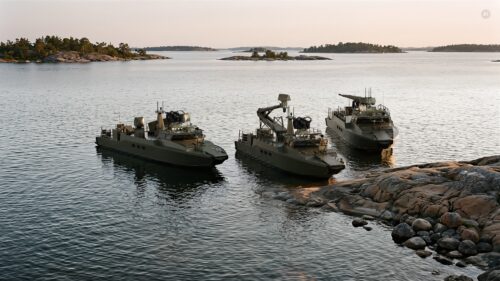
Graphic: Saab
The new vessel, called Combat Boat 90 Capability X (CB90 CX), was announced on Nov. 2. It will be offered in three configurations: intelligence, surveillance and reconnaissance (ISR), anti-ship warfare, and SHORAD. Sweden is the launch customer, and the boat is already in production for that country.
For the aviation sector, the air-defense element of the program is the most relevant development. Saab says the SHORAD version uses an anti-aircraft autocannon and was designed with the growth of uncrewed air systems in mind. Small, cheap drones are a concern for maritime nations and any country with a coastline. A compact boat that can carry a gun and sensors offers a way to push air defense further out to sea, so that drones can be engaged before they reach the coast.
The CB90 CX is larger than the existing CB90 NG, which Saab describes as a popular vessel trusted in service around the world. The company says the extra size brings more payload capacity and a comprehensively updated set of onboard systems, and that the boat can operate across a wider range of sea states. That last point matters for anything that has to aim a sensor or a gun from a moving hull.
The CB90 CX is designed for optional crewing using Saab’s Autonomous Ocean Core, so it can be operated with or without people on board. Saab says it keeps the characteristics that made earlier troop-carrying versions well regarded, while leaving room for a broader range of capabilities. The CB90 family serves in nine navies across Europe, the Middle East, Africa, Asia Pacific and the Americas, which gives the company a ready pool of potential export customers.
The ISR version is built around Saab’s Giraffe 1X radar and focuses on multi-domain situational awareness. Giraffe 1X is a radar Saab already uses for air surveillance, so this variant could contribute to the air picture as well as the surface picture, though the company has not said how. The anti-ship version provides over-the-horizon strike against surface vessels. The SHORAD version is the one aimed at aircraft and drones.
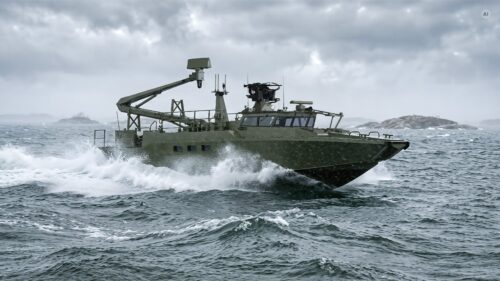
A graphic released by Saab shows the ISR configuration in more detail. The radar antenna is carried on an articulated arm that rises from the aft deck and extends outward and upward, lifting the antenna clear of the superstructure and the deck equipment. A camera or electro-optical sensor head appears to hang beneath the antenna. Saab says this variant uses the Giraffe 1X, and the graphic presumably shows that radar, although it is not labelled. Mounting a radar on an arm instead of directly on the cabin roof would normally give it a higher and less obstructed view, which helps when looking for low-flying targets and when working close to a coastline. Saab has not said how high the arm reaches or whether it folds down for transport or heavy weather.
A remote weapon station (RWS) sits on the cabin roof and carries what looks like a machine gun, intended for self-defence. Because the station is operated remotely, the weapon can be fired without anyone exposed on deck. Several smaller antennas on the mast and cabin roof are also visible, but the graphic does not identify them.
Graphic: Saab
Saab presents the three as complementary. Operated together, or as part of a wider joint force, they would give a navy a sensing boat, a striking boat and a defending boat that share information. Anders Hellman, head of Saab’s business unit Docksta, framed the thinking in the company’s announcement. He said the future of naval operations is less about having more platforms and more about distributing combat capability across the force, and that the CB90 CX moves beyond troop transport to connect sensors and weapons, whether the boat is crewed or uncrewed.
The release describes these as the three initial configurations, which suggests Saab expects to add others. It did not say what they might be.
The release is short on technical detail. Saab has not named the autocannon or the fire-control system, and it does not say whether missiles could be added to the air-defence version. It also gives no figures for dimensions, displacement, speed, range or payload, and no information on the size, value or delivery schedule of the Swedish order.
There are practical questions too. Autocannons can be effective against slow, low-flying drones at short range, but their usefulness against larger groups of targets, or against faster threats, depends on the sensors, the rate of fire and the amount of ammunition carried. How the SHORAD boat would connect to land-based and airborne sensors is also unclear, as is how much autonomy will be available at delivery. If a boat is operating without a crew, there is the further matter of who authorises the use of weapons against an airborne target and under what rules.
Those answers will determine whether the CB90 CX becomes a useful part of layered air defence or stays a niche option. For now, Saab has shown that it sees small, distributed platforms as part of the response to cheap aerial threats, and that Sweden is willing to pay for the idea. Further details are likely to emerge as production continues and as other CB90 operators consider what the new boat could do for them.
For more information, hit the Source below