General Atomics Aeronautical Systems and Saab have completed the first flight of what the two companies describe as the world’s first unmanned Airborne Early Warning solution, marking a significant step in efforts to bring persistent AEW surveillance to regions and missions where manned platforms are unavailable or impractical.
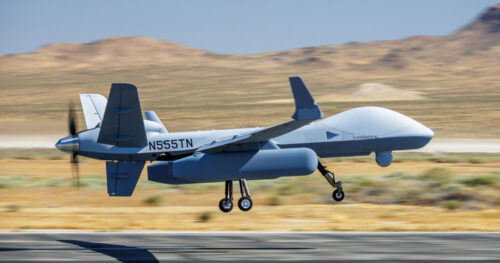
Photo: GA-ASI
The validation flight took place on 19 May at GA-ASI’s Desert Horizon flight operations facility in Southern California, where a company-owned MQ-9B remotely piloted aircraft flew carrying Saab’s LoyalEye AEW radar pods. The flight was deliberately limited in scope. It represents the opening move of a development process expected to span several months and conclude with a full capability demonstration before the end of the year.
The two companies announced their partnership in 2025, with the stated aim of integrating LoyalEye onto the MQ-9B platform. GA-ASI brings to the program its extensive experience operating large remotely piloted aircraft, with the Predator family having accumulated more than nine million flight hours over three decades. Saab, for its part, is an established name in airborne early warning, with its manned GlobalEye AEW&C system already in operational service. LoyalEye is the unmanned derivative of that sensor lineage.
The capability case for an unmanned AEW platform centers on a combination of endurance and risk reduction. GA-ASI president David R. Alexander pointed to the medium-altitude, long-endurance characteristics of the MQ-9B as giving it the highest operational availability of any military aircraft type, while the unmanned nature of the platform means aircrews are kept out of harm’s way. The system is intended to detect and track tactical air munitions, guided missiles, drones, and crewed combat aircraft. It will operate across both line-of-sight and satellite communication links, and is designed to handle simultaneous tracking of multiple targets.
Carl-Johan Bergholm, Saab’s senior vice president and head of business area surveillance, described LoyalEye as a complement to existing manned assets rather than a replacement, saying the system is aimed at extending operational reach and improving situational awareness in combination with other platforms.
The MQ-9B family encompasses several variants that could eventually carry the system. These include the SkyGuardian and SeaGuardian, the United Kingdom’s Protector variant, and a short takeoff and landing configuration currently in development for naval carrier operations. GA-ASI has positioned the AEW offering as addressing a gap in coverage, particularly in areas where persistent air surveillance is currently out of reach.
With the validation flight now completed, the program moves into a structured test and evaluation phase. A full capability demonstration is planned for later in 2026, after which the companies expect to make the system available to existing MQ-9B operators and prospective new customers.
For more information, hit the Source below