The U.S. Navy has confirmed that the prototype AN/ALQ-264 Beowulf, a new sensor for the Boeing EA-18G Growler, flew in 2025. The F/A-18 and EA-18G Program Office (PMA-265) disclosed the flight test on Sept. 1 while announcing that the Growler Block II Beowulf team had won a 2026 Naval Air Systems Command (NAVAIR) Commander’s Award for Technical Innovation.
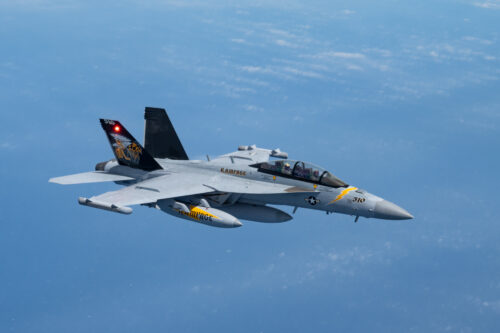
The press release from NAVAIR describes it as having a digital active electronically scanned array (AESA) built into an aircraft flight control surface, which the Navy calls a first for tactical aviation. It puts the development effort at about six years. Until now, most public detail on the program came from a March contract announcement covering engineering and test hardware.
The Navy says evolving threats are pushing the EA-18G to operate at longer ranges, which calls for faster sensing, identification and targeting options to secure the contested electromagnetic spectrum. Beowulf is meant to help close that gap. The release gives no range or performance figures, and it comes from the program office as a courtesy story.
The Journal of Electromagnetic Dominance (JED) reports that Beowulf’s array is integrated into the Growler’s inboard leading edge flaps. There it augments the existing AN/ALQ-218 receiver. JED also credits Northrop Grumman in Baltimore with developing the array.
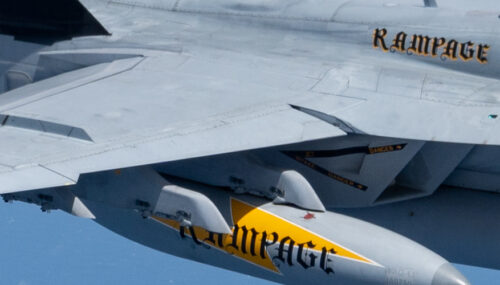
JED describes Beowulf as part of the Growler Block II upgrade, in its Phase II. Phase I is a separate effort called the Next Generation Electronic Attack Unit (NGEAU), which has its own contract and schedule.
The release says the team flight-tested the prototype in 2025 and that the demonstration validated the concept’s operational promise. It does not give the date, location or test objectives. The Navy lists the technical hurdles as digital radio frequency processing, thermal management, manufacturing, flight-clearance planning and installation, and says the work involved government, industry and international partners.
The Royal Australian Air Force provided cooperative development support, according to the release, which says that reflects allied interest in the capability’s long-term value. Capt. Michael Burks, the F/A-18 and EA-18G program manager, said the team “stayed after the problem until they delivered a capability.” He added that it will help shape the future of airborne electronic attack.
On Mar. 13, the Pentagon’s daily contract announcement listed an order to Boeing in St. Louis for the Beowulf upgrade. The order is a not-to-exceed $489,306,966 cost, undefinitized order under an existing basic ordering agreement, meaning the final terms and price have not yet been settled. The Navy obligated $33,988,353 in fiscal 2026 research, development, test and evaluation funds at award. The order was not competed.
The money covers non-recurring engineering and associated test assets. That includes four Beowulf A-Kits, four Gunbay Pallet A-Kits, 12 Beowulf B-Kits, 15 sensor control unit B-Kits and nine power control unit B-Kits, along with support equipment. Work is expected to finish in February 2030.
For more information, hit the Source below